
- in Uncategorized by Marina Koker
✈️ How to Understand Russian Airport Announcements: Arrival & Baggage Claim
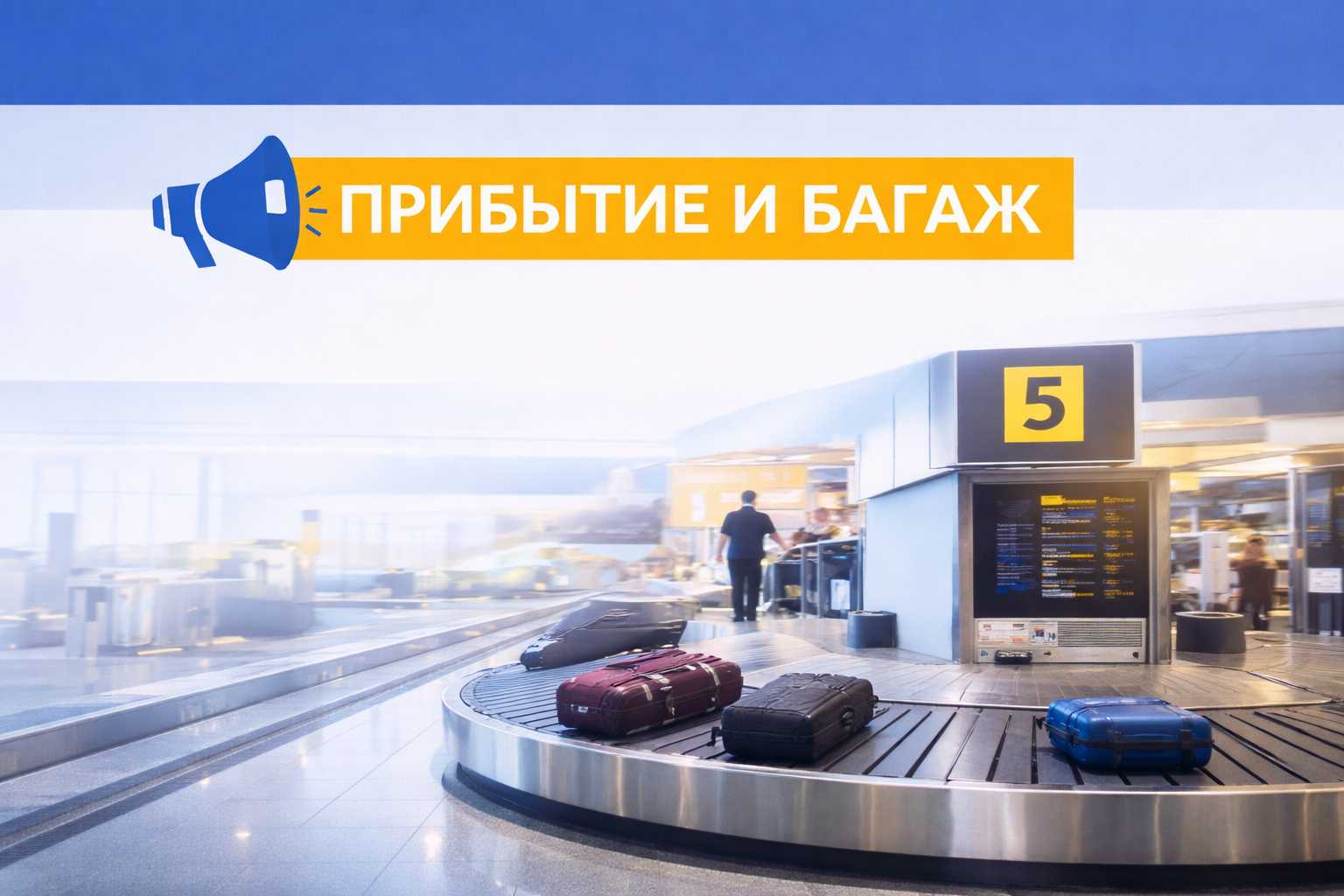
You may feel confident speaking Russian. But the moment you land in a Russian airport and hear a formal announcement… everything suddenly sounds heavier.
More bureaucratic. More compressed. More “official.” Airport Russian is not conversational Russian. It is institutional Russian.
Today, let’s decode a real arrival and baggage claim announcement.
🎧 The Announcement
Вниманию встречающих. Рейс SU 101 из Владивостока прибыл в аэропорт. Получение багажа осуществляется на ленте номер 5. Пассажирам, не обнаружившим свой багаж, просьба обратиться в службу розыска багажа.
🧳 What Does It Mean?
Let’s break it down step by step.
Вниманию встречающих
Literally: “To the attention of those meeting (passengers).”
This is a very formal, compressed structure typical of public announcements.
You will rarely hear this in everyday conversation.
Рейс SU 101 прибыл в аэропорт
прибыл — arrived (perfective verb)
Notice the form.
The announcement does not say “самолёт прилетел” (the plane flew in).
It uses “рейс” (flight) instead of “самолёт” and a formal verb “прибывать/ прибыть” (to arrive) that can be applied for any kind of transportation (plane, train, car, ship)
This is an official register.
Получение багажа осуществляется на ленте номер 5
This is where it gets interesting.
осуществляется = “is being carried out/ implemented”
“Получение” is a formal subject here, it is an action, and there is no visible agent.
Lit. “Receiving a luggage is implemented at the conveyer belt number 5.“
Transl. “Baggage claim is at carousel number 5”.
This impersonal construction is extremely common in airports.
Airport Russian removes the actor and focuses on the process. The implication – anyone who completes the action.
That’s why it feels heavy.
Пассажирам, не обнаружившим свой багаж, …
Here we see compression again, with formal Russian.
Instead of saying: “Пассажирам, которые не обнаружили …”
The announcement uses a verbal participle “не обнаружившим”
This structure:
• shortens the sentence
• increases formality
• sounds official
You will hear this type of construction in:
- airports
- train stations
- legal documents
- government offices
It is not casual speech, it is very formal Russian. That is why it uses the formal verb “обнаруживать/ обнаружить” вместо neutral “находить/ найти” for “to find” – “Passengers who not found their luggage,…”
просьба обратиться в службу розыска багажа
This is a classic institutional command.
Instead of directly telling you what to do, it uses:
просьба + infinitive: “Request to contact…”
It softens the order while keeping authority.
Trans. “Please contact the lost luggage service”: 1) обращАться/ обратИться КУДА – to contact, 2) рОзыск багажА – lost baggage
Why Airport Russian Feels Difficult
Not because of vocabulary.
But because of:
• Passive type of constructions
• Using verbal participles inctead of sentences with который
• Formal tone
• Compressed phrasing
• Formal choice of the words
Quick Practice
Try rewriting this in the casual style:
“If you did not find your luggage, please contact lost luggage.”
Answer:
Если вы не нашли свой багаж, обратитесь в отдел потерянного багажа.
If that felt slightly uncomfortable — that’s normal. This is advanced register.