
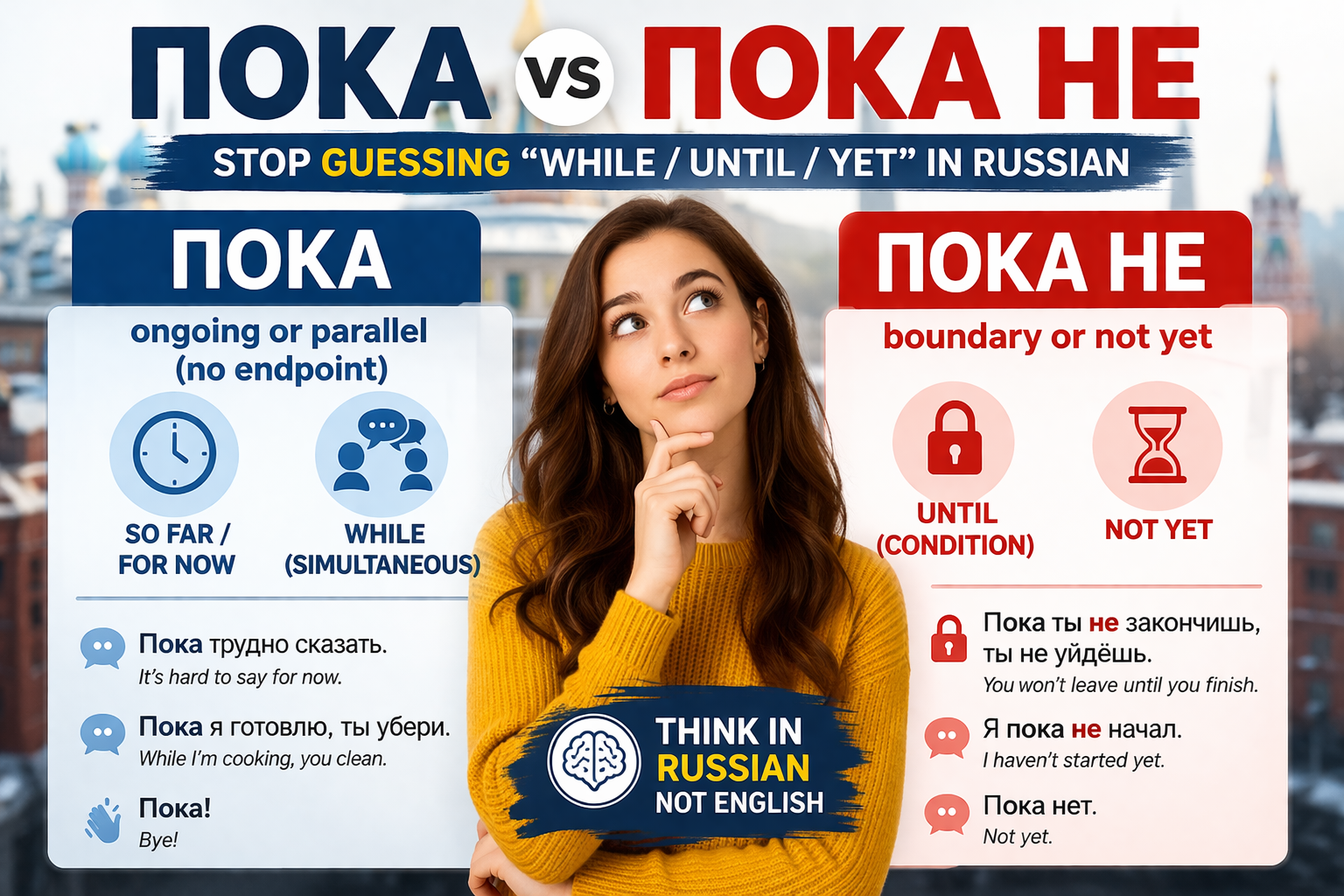
You may know the words:
- пока = while or bye
- пока не = until or not yet
But in real conversation?
You hesitate.
You translate.
You guess.
And sometimes—you’re wrong.
That’s not just a vocabulary problem.
That’s more like a structure problem.
If you don’t hesitate the logic of these structures, you stay stuck at Intermediate.
So, let’s make it clear for you.
1. ПОКА (temporal or parallel actions)
Meaning 1: “Bye” 
You know this meaning of ПОКА. It was derived from one of the main meaning of ПОКА (“for now”) but in modern Russian, it has lost it connections with this meaning. Different word function now – just informal “Bye!”.
Examples
- Ну, ладно, мне пора. Пока! Well, okay, it’s time for me to go. Bye!
- Пока! До завтра! Bye! See you tomorrow!
Usage
Since it’s informal, make sure you don’t use it with people that you address formally (with “Вы”).
Meaning 2: “So far, for now, meanwhile” 
Used when something is still true at this moment.
Part of speech
In this meaning, ПОКА is an adverb.
Structure
It is used in simple sentences.
Verb Form
The verb is in the Imperfective Present or Future tense (ongoing action)
Examples
- Переговоры пока продолжаются. Negotiations are ongoing so far.
- Пока трудно сказать. It’s hard to say for now.
- Пока США будут продолжать помогать Украине. Meanwhile, the U.S. will continue help Ukraine.
👉 Think: no endpoint yet, just a temporary status that can change at any time
Meaning 3: “While” (two simultaneous actions) 
Two actions at the same time. One action is happening while the other action is going on too.
Part of Speech
In this meaning ПОКА is a conjunction.
Structure
In a complex sentence – introduces a subordinate clause.
Verb Form
In a clause with ПОКА, the verb is Imperfective —Present, Past, or Future. Both clauses have the same form of the verb.
- Пока жена готовит, муж моет посуду . While the wife is cooking, the husband does the dishes.
- Пока я буду ехать в метро, я буду слушать музыку. I’ll listen to music while I’ll ride the subway.
- Пока шел дождь, мы сидели дома. While it was raining, we stayed home.
- Пока я учился в институте, я жил с родителями. While I was in college, I lived with my parents.
- Не отвлекай меня, пока я работаю. Don’t distract me while I’m working.
👉 Think:
“These two actions happen (will happen/ happened) together.”
2. ПОКА НЕ (boundary)
This is not just vocabulary.
This is logic of completion.
Meaning 1: “Until” 
Used when means a condition that must be completed: the action 2 can’t start until the action 1 is completed.
Part of speech
In this meaning, ПОКА НЕ is a conjunction.
Structure
In a complex sentence – introduces a subordinate clause. НЕ goes in front of the verb. The typical structure of this clause is: ПОКА + Subject + НЕ + Verb.
Verb Form
Conjunction ПОКА НЕ → Perfective verb – Past or Future (completed action}
This is where the English verb forms coordination is different! See examples.
Examples
- Пока не выучишь уроки, не пойдёшь гулять. You can’t go out until you’ve finished your homework.
- Пока я не закончу этот проект, я не смогу взять отпуск. Until I finish this project, I won’t be able to take a vacation.
- Я буду заниматься с ним, пока он не научится это делать. I’ll keep practicing with him until he gets the hang of it.
- Он жил с родителями, пока не закончил интститут. He lived with his parents until he graduated from college..
- Я подожду, пока он не позвонит мне. I’ll wait until he calls me.
👉 Think:
- Action = NOT completed yet
- Completion = required to unlock next step
Meaning 2: “Not yet”
Part of Speech
In this meaning, ПОКА НЕ is an adverb.
Structure
It is used in simple sentences.
Verb Form
- With Perfective Past verb it means “started but didn’t complete the action” (implied “plan to complete”)
- With Imperfective Past verb it means “hasn’t started the action yet” (implied “may consider it”}
- With Imperfective Future verb it means “
Examples
- – Вы позвонили партнёрам? — Пока нет. – Did you call our partners? – Not yet.
- Я пока не начинала этот проект I haven’t started this project yet. (Imperf. Past – implied “may consider doing it”)
- Я пока не решила. I haven’t decided yet. (Perf. Past – implied “plan to do it”
- Пока не знаю. I don’t know yet.
- Я пока не буду об этом думать. I’m not going to think about that just yet
👉 Think: “Still not.”
3. The decision rule
| If you mean… | Use |
|---|---|
| simple sentence/ 1 action / “meanwhile” meaning | пока (adverb) |
| complex sentence/ 2 actions at same time | пока (conjunction) |
| complex sentence/ 2 actions: action 1 must be completed before the action 2 starts | пока не – for action 1 (conjunction) |
| simple sentence/ 1 action/ “not yet” meaning | пока не (adverb) |
If you hesitate here → you don’t know it yet.
Exercise 1. Choose ПОКА / ПОКА НЕ
- ____________ я читаю, не мешай мне.
- Мы не начнём, _________ он _____ придёт.
- Я _______________ готов принять это решение.
- ______________ мне сложно в это поверить.
- _______________ они только обсуждают проблему, ситуация не меняется.
Exercise 2. Translate into Russian
- I’ll wait until you finish.
- While I’m working, don’t call me.
- I haven’t decided yet.
- Negotiations are still ongoing.
- You won’t go out until you clean your room.
Exercise 3. Fix the mistake
- Пока ты не делаешь домашнее задание, не пойдёшь гулять.
- Я пока знаю это.
- Пока я приготовлю ужин, ты убираешь квартиру.
- Я буду сидеть дома, пока закончится дождь.
Exercise 4. Build your own sentence
Write:
- 2 sentences with пока (while)
- 2 sentences with пока (so far)
- 2 sentences with пока не (until)
If you can’t do this quickly → you don’t own this structure.
Answers
Exercise 1
- пока
- пока не
- пока не
- пока
- пока
Exercise 2
- Я подожду, пока ты не закончишь.
- Пока я работаю, не звони мне.
- Я пока не решил(а).
- Переговоры пока продолжаются.
- Пока ты не уберёшь комнату, не пойдёшь гулять.
Exercise 3
- ❌ делаешь → ✔ сделаешь
- ❌ знаю → ✔ не знаю
- ❌ убираешь → ✔ уберёшь (both tenses need to be the same: if the first one is Perf. Future, the second one should be Pref. Future too)
- ❌ закончится → ✔ не закончится (2 actions. Action of the rain needs to be completed first).
5. Why this matters (and why you’re still stuck)
Most Intermediate learners:
- understand grammar
- know vocabulary
- but don’t control structures under pressure
That’s why:
- you translate
- you hesitate
- you simplify your speech
And your Russian stops growing.
6. What actually fixes this
Not more rules.
Not more reading.
You need:
- structured repetition
- real-life patterns
- listening + speaking integration
- controlled progression
That’s exactly what most self-study learners are missing.
7. If you want to stop guessing Russian
This is exactly what we train inside METRO: Conversational Russian
- real-life topics (not textbook fragments)
- high-frequency structures like ПОКА / ПОКА НЕ
- audio-first training (so you stop translating)
- step-by-step system that builds automatic speech
Start here (70% OFF entry point)
METRO Book 1. Daily Routine
✔ 600+ real conversational words
✔ 70+ minutes of audio
✔ structured system to move beyond Intermediate
👉 If you’re serious about breaking the plateau, this is your next step.
Final check
Can you say instantly:
“I’ll wait until you call me”
without translating?
If not—you don’t know this yet.
And that’s exactly what you need to fix next.
To start building real, everyday Russian, not textbook Russian –
→ Get METRO “Book 1. Daily Routine”