
How to say I UNDERSTOOD at different levels

Using synonyms in a foreign language is one of the clearest signs that a learner is moving beyond survival communication toward real fluency. Synonyms allow you to sound more precise, more natural, and more culturally aware. Instead of repeating the same basic word again and again, you can adjust your speech to the situation: formal or informal, emotional or neutral, spoken or written. This flexibility is exactly what native speakers expect—and immediately notice—when someone truly “owns” the language rather than just gets by.
At the same time, learning synonyms is hard. For foreign-language students, synonyms often look interchangeable but they are usually not fully.
They differ in
- Register (formality),
- Frequency,
- Emotional tone,
- and—very importantly—government, meaning the grammatical form they require (cases, prepositions, or structures).
Many learners get stuck at the Intermediate plateau precisely because they recognize synonyms passively but avoid using them actively, afraid of choosing the wrong word or the wrong grammatical form. This fear leads to safe but repetitive language—and stalled progress.
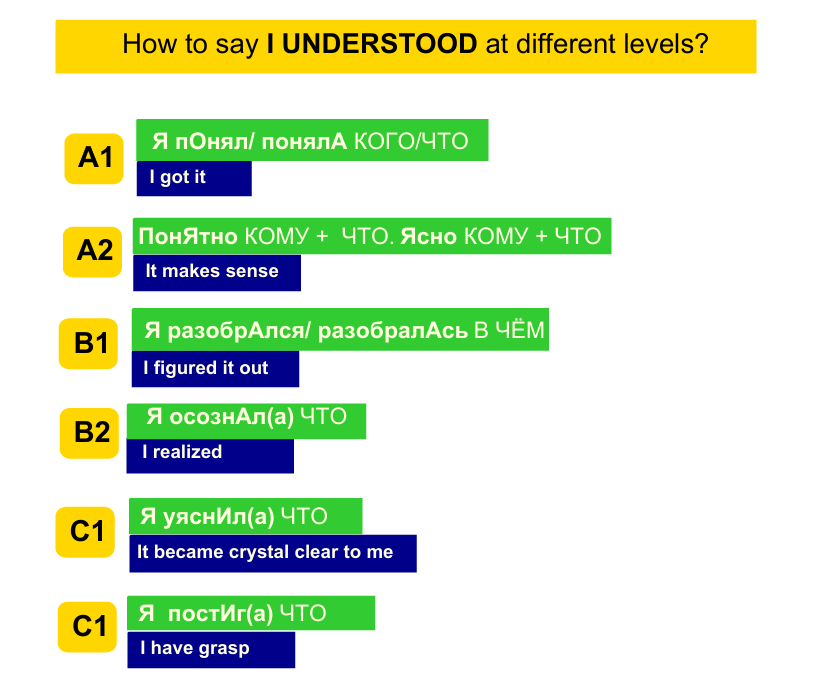
Let’s look at a simple idea: saying “I understood” in Russian at different levels.
🟡 A1 — Я пОнял / Я понялА КОГО / ЧТО
Meaning: I got it / I understood.
Usage: This is the most basic and universal option. You use it in everyday spoken Russian when reacting to information, instructions, or explanations.
Style: Neutral, conversational.
Government: Accusative (КОГО / ЧТО)
✔ Я понял вопрос.
✔ Я поняла тебя.
👉 At A1, this is your safe, all-purpose phrase.
🟡 A2 — ПонЯтно КОМУ + ЧТО / Ясно КОМУ + ЧТО
Meaning: It makes sense / It’s clear.
Usage: Instead of “I,” Russian shifts focus to the state of clarity. Very common in polite conversation and explanations.
Style: Neutral, slightly more mature than A1.
Government: Dative (КОМУ) + Accusative (ЧТО)
✔ Мне это не понятно.
✔ Ей ясно, почему он это сказал.
✔ Тебе нужно сделать это завтра. Понятно? – Понятно.
👉 This structure is a big step toward natural Russian thinking.
🟡 B1 — Я разобрАлся / разобралАсь В ЧЁМ
Meaning: I figured it out.
Usage: Emphasizes process and effort. You didn’t just understand—you worked through confusion.
Style: Conversational, confident.
Government: В + Prepositional (В ЧЁМ)
✔ Я разобрался в этой теме.
✔ Она разобралась в инструкции.
👉 Perfect for problem-solving, learning, or technical contexts.
🟡 B2 — Я осознАл(а) ЧТО
Meaning: I realized.
Usage: Marks a mental or emotional shift—often sudden or important.
Style: Reflective, serious.
Government: Accusative (ЧТО)
✔ Я осознал, что был неправ.
✔ Она осознала свою ошибку.
👉 This word signals deeper awareness, not just comprehension.
🟡 C1 — Я уяснИл(а) ЧТО
Meaning: It became crystal clear to me.
Usage: Indicates complete clarity after explanation or analysis. Common in formal speech, lectures, or writing.
Style: Semi-formal to formal.
Government: Accusative (ЧТО)
✔ Я уяснил, как работает система.
👉 Sounds educated and controlled—excellent for academic Russian.
🟡 C2 — Я постиг(ла) ЧТО
Meaning: I have grasped / I have comprehended deeply.
Usage: Expresses deep, often abstract understanding—ideas, philosophy, life lessons.
Style: High-level, literary, intellectual.
Government: Accusative (ЧТО)
✔ Он постиг суть проблемы.
✔ Она постигла смысл жизни.
👉 This is not everyday Russian—it signals mastery.
Key takeaway
As you can see, these verbs are not interchangeable, even though they all could technically be translated as “I understood.”
To sound natural and advanced, always learn:
- the MEANING
- the CONTEXT
- and the GOVERNMENT FORM
That’s exactly how you move from repeating Я понял forever to speaking Russian with confidence, nuance, and authority.
Learning synonyms is not about memorizing word lists. It’s about learning meaning + context + Government together.
When you train yourself to notice how each synonym behaves grammatically and stylistically, your confidence skyrockets—and so does your fluency. This is exactly where real progress happening!