
- in Russian Language by Marina Koker
“Wiping Things” in Russian

At the Intermediate level, vocabulary gaps are rarely about big words.
They’re about small, everyday objects that Russians use constantly — and name very precisely.
Today’s vocab group is all about wiping, drying, and cleaning.
Many learners know one word — and use it everywhere. Russians don’t.
Let’s fix that.
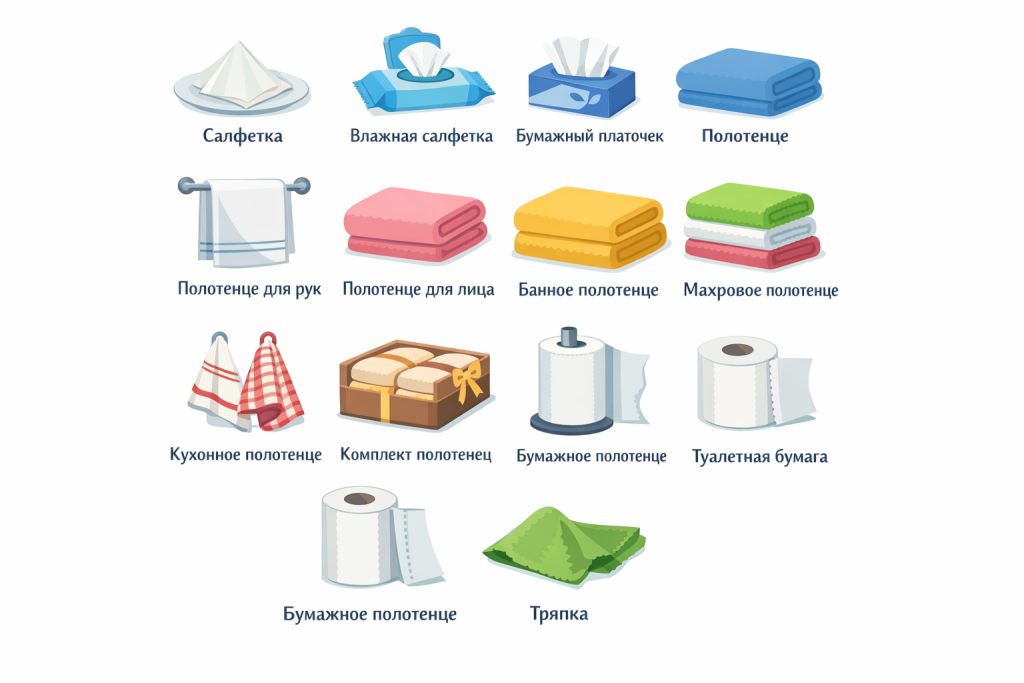
Nouns Russians Use with “Wiping Things”
1️⃣ салфе́тка napkin
A table napkin, usually paper, sometimes cloth.
Example:
👉 Передайте мне салфетку, пожалуйста. Please pass me a napkin.
2️⃣ вла́жная салфе́тка wet wipe
Used for hands, face, kids, travel.
Example:
👉 У меня всегда есть с собой на всякий случай влажные салфетки. I always have wet wipes with me just in case.
3️⃣ бума́жный плато́чек tissue
For nose, sneezing, light wiping. Plural – плато́чки.
Example:
👉 У тебя нет бумажных платочков? Do you have tissues?
4️⃣ полоте́нце towel
A general term for all kinds of towels. Used when the type of towel is clear from context. It’s neuter gender. Plural Nominative – полоте́нца. Plural Genitive – полоте́нец (У нас нет полотенец).
Example:
👉 Не знаешь, где у нас лежат чистые полотенца? Do you know where we keep the clean towels?
5️⃣ полоте́нце для рук hand towel
Small size towel, usually near the sink.
Example:
👉 В ванной висит отдельное полотенце для рук. There’s a special hand towel in the bathroom.
6️⃣ полоте́нце для лица́ face towel
Small size towels used only for the face (important in Russian households).
Example:
👉 Это полотенце для лица, а не для рук. This towel is for the face, not for hands.
7️⃣ ба́нное полоте́нце — bath towel
Large towel used after shower or bath.
Example:
👉 Пора постирать банные полотенца. It’s time to wash the bath towels.
8️⃣ ма́хровое полоте́нце plush towel
Describes the material, not the size.
Example:
👉 Я люблю махровые турецкие полотенца. I like Turkish plush towels.
9️⃣ ку́хонное полоте́нце — kitchen towel
For hands, dishes, surfaces in the kitchen.
Example:
👉 У них кухонные полотенца висят рядом с раковиной. Their kitchen towels are near the sink.
🔟 компле́кт / набо́р полоте́нец set of towels
Often sold or mentioned together.
Example:
👉 Мы купили комплект полотенец для ванной. We bought a set of towels for the bathroom.
1️⃣1️⃣ бума́жное полоте́нце paper towel
Disposable, used for cleaning or drying.
Example:
👉 У нас закончились бумажные полотенца. We’re out of paper towels.
1️⃣2️⃣ туалетная бума́га toilet paper
No explanation needed. Use it as singular only. When you want to count them, use the word “рулОн” (roll) with it
Example:
👉 – Не забудь купить туалетную бумагу. – Хорошо. А сколько? – Пять рулонов. Don’t forget to buy toilet paper. – Sure. How many? – Five rolls.
1️⃣3️⃣ тря́пка / тря́почка (coll.) rag, cleaning cloth
Informal, very common in spoken Russian.
Example:
👉 Возьми тряпку и вытри пол. Take a rag and wipe the floor.
🚿 Quick Review of Core Nouns
- полотенце / банное полотенце / полотенце для рук/ полотенце для лица/ махровое полотенце/ кухонное полотенце/ набор = комплект полотенец
- салфетка / влажная салфетка
- бумажный платочек
- бумажное полотенце
- туалетная бумага
- тряпка
✏️ Let’s Practice
🟡 Exercise 1: One word — one situation
Which word fits best?
a) Nose, sneezing → _____________________________
b) Kitchen surfaces → _____________________________
c) After shower → _________________________________
d) Hands after washing → ________________________
e) Wiping the table → _____________________________
🟡 Exercise 2: Explain the difference (in English or Russian)
- бумажный платочек vs салфетка
- банное полотенце vs полотенце для рук
- тряпка vs бумажное полотенце
Verbs Russians Use with “Wiping Things”
Knowing the nouns is only half of the job.
Now let’s look at the verbs Russian used when they talk about “wiping things. There are several of them. Let’s looks at them and pay attention to:
a) what type of action they describe,
b) what government form (the form of the noun after them) they require,
c) if they have standard or non-standard forms,
| Verb | Meaning | Government form |
|---|---|---|
| вытира́ть / вы́тереть | to wipe, to dry (off), to clean | кого/ что + чем |
| вытира́ться / вы́тереться | to dry oneself | чем |
| суши́ть / вы́сушить | to dry | что + чем |
| промока́ть / промокну́ть | to blot, to dab | что + чем |
| сморка́ться / вы́сморкаться | to blow one’s nose | во что |
1️⃣ вытира́ть / вы́тереть КОГО/ ЧТО + ЧЕМ
to wipe smth/sbd with smth, to dry (off) sbd with smth, to clean smth with smth
Usage
This is the most general verb of this group. It can be used to describe removing either water, or dirt from something or someone with some tool. This is the only verb of this group that can have a direct object as both, a person (вытереть КОГО), and a thing (вытереть ЧТО). The tools is expressed with the Instrumental case form of a noun.
Forms
The Imperfective verb вытира́ть has all standard forms: Present (вытира́ю, вытира́ешь, вытира́ют), Past (вытира́л, вытира́ла, вытира́ли), and Future (буду/ будешь/ будут вытира́ть).
The Perfective verb вы́тереть use the root – тр- in the Future tense (вы́тру, вы́трешь, вы́трут) and non-standard masculine Paste tense (вы́тер) while standard other Past tense forms (вы́терла, вы́терли).
Examples:
👉 Он вы́тер ребенка полотенцем после душа. He dried the child with a towel after the shower.
👉 Она вытира́ет руки полотенцем. She is wiping/ drying her hands with a towel.
2️⃣ вытира́ться / вы́тереться ЧЕМ
to dry oneself with smth
Reflexive form — the focus is on yourself. It is used to describe removing water from oneself with some tool. The tools is expressed with the Instrumental case form of a noun.
Forms
The Imperfective verb вытира́ться has all standard forms: Present (вытира́юсь, вытира́ешься, вытира́ются), Past (вытира́лся, вытира́лась, вытира́лись), and Future (буду/ будешь/ будут вытира́ться).
The Perfective verb вы́тереть use the root – тр- in the Future tense (вы́трусь, вы́трешься, вы́трутся) and non-standard masculine Paste tense (вы́терся) while standard other Past tense forms (вы́терлась, вы́терлись).
Examples:
👉 После купания он вы́терся рубашкой, потому что забыл дома пляжное полотенце.
After swimming he dried himself with his shirt because he forgot his beach towel at home .
👉 Дочка обычно вытира́ется махровым полотенцем. My daughter is usually drying herself with a plush towel.
3️⃣ суши́ть / вы́су́шить ЧТО + ЧЕМ
to dry (completely) smth with smth
Usage
Used when the goal is dryness, not wiping motion. It is used to describe removing water completely from something with some tool, to make something dry (сухой). The direct object is a thing (сушить ЧТО). The tools is expressed with the Instrumental case form of a noun.
Forms
The Imperfective verb суши́ть has a shifting stress pattern in the Present forms (сушу́, су́шишь, су́шат) and standard forms in the Past tense (суши́л, суши́ла, суши́ли) and Future tense (буду/ будешь/ будут суши́ть).
The Perfective verb вы́сушить has standard both Future (вы́сушу, вы́сушишь, вы́сушат) and Paste tense forms (вы́сушил, вы́сушила, вы́сушили.
Examples:
👉 Она обычно су́шит волосы полотенцем, а не феном. She usually dries her hair with a towel and not with a hair drier.
👉 Я вы́сушил руки бумажным полотенцем. I dried my hands with a paper towel.
4️⃣ промока́ть / промокну́ть ЧТО + ЧЕМ
to blot smth with smth, to dry smth with smth
Usage
It is used to describe removing liquid with some tool as a soft, careful action, without rubbing. The direct object expresses only a thing (промокнуть ЧТО). The tools is expressed with the Instrumental case form of a noun.
Forms
The Imperfective verb промока́ть has all standard forms: Present (промока́ю, промока́ешь, промока́ют), Past (промока́л, промока́ла, промока́ли), and Future (буду/ будешь/ будут промока́ть).
The Perfective verb промокну́ть has also standard both Future (промокну́, промокнёшь, промокну́т) and Paste tense forms (промокну́л, промокну́ла, промокну́ли).
Examples:
👉 Промокни лицо салфеткой. Blot your face with a napkin.
👉 Она промокну́ла воду на столе бумажным полотенцем. She dried the water from the table with a paper towel.
5️⃣ сморка́ться / вы́смо́ркаться (ВО ЧТО)
to blow one’s nose into something
Usage
This verb is used to describe removing liquid with some tool as a soft, careful action, without rubbing. The direct object expresses only a thing (промокнуть ЧТО). The tools is expressed with the Instrumental case form of a noun.
The Imperfective verb сморка́ться has all standard forms: Present (сморка́юсь, сморка́ешься, сморка́ются), Past (сморка́лся, сморка́лась сморка́лись), and Future (буду/ будешь/ будут сморка́ться).
The Perfective verb вы́сморкаться has also all standard forms: Future (вы́сморкаюсь, вы́сморкаешься, вы́сморкаются) and Past (вы́сморкался, вы́сморкалась вы́сморкались).
Examples:
👉 Он громко вы́сморкался в бумажный платочек. He blew his nose loudly into a tissue.
👉 Не сморка́йся в салфетку, пожалуйста. Возьми носовой платок Don’t blow your nose into a napkin, please. Take a handkerchief.
✏️ Let’s practice
🟡 Exercise 1: Choose the correct verb
- После душа он обычно долго __________________________ полотенцем.
- Она _____________________ стол бумажным полотенцем.
- Она аккуратно _________________ лицо салфеткой.
- Он _________________ в бумажный платочек.
🟡 Exercise 2: Choose the correct form
(вытирать / вытираться / сушить / промокать)
- Она __________________ волосы полотенцем.
- После бассейна дети ____________.
- ____________ руки после мытья.
- ____________ стол тряпкой.
🟡 Exercise 3: Explain the difference (short answer)
- вытирать vs сушить
- вытирать vs промокать
🚇 Takeaway
Intermediate learners often know the noun but use the wrong verb — or the wrong case.
Native Russian is built on fixed, automatic verb–noun patterns.
Mastering these small combinations is what makes your speech:
- natural
- precise
- confidently Advanced
🚇 Why this matters
At the Intermediate level, precision beats volume.
Knowing which exact word fits which daily situation is what:
- makes your Russian sound natural
- prevents awkward mistakes
- helps you think in Russian, not translate
This is how you move off the Intermediate plateau — one realistic vocab group at a time.
NEXT STEP
If this lesson felt useful, that’s not an accident. This is exactly how our METRO: Conversational Russian textbook series is built — real-life vocabulary, natural verb–noun combinations, and guided audio that trains you to think in Russian, not translate. If you’re tired of the Intermediate plateau and want steady, visible progress, start with METRO Book 1. It lays the foundation that makes every next topic easier, clearer, and more automatic — and helps you finally move from “I understand” to confident, natural speech.