
How to Say “I Agree” in Russian: 25+ Natural Expressions
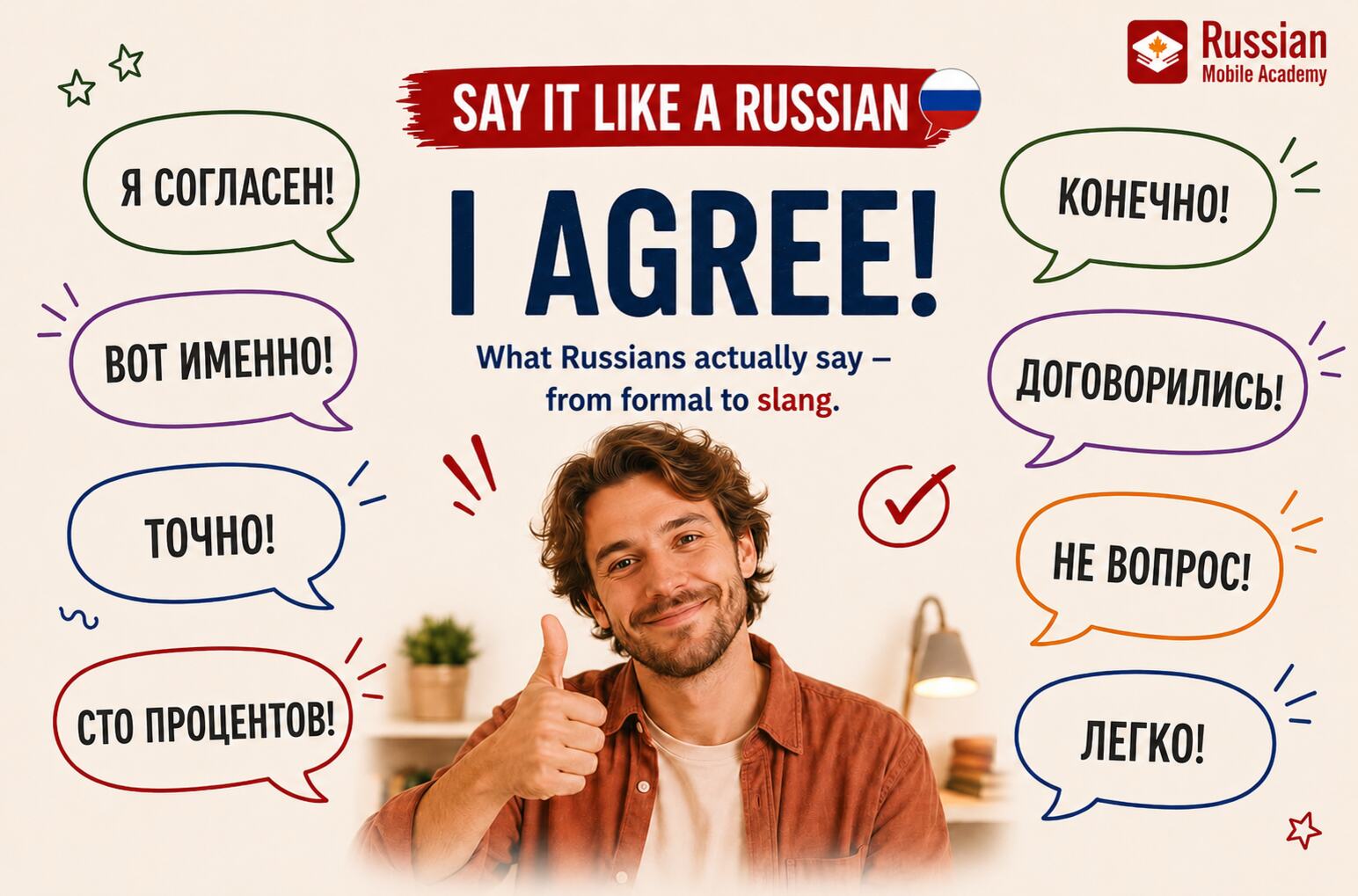
Wondering how to say “I agree” in Russian?
Я согла́сен or Я согла́сна is only the beginning.
Russian speakers choose different expressions depending on whether they agree with an opinion or agree to do something—and whether the situation is formal, neutral, colloquial, or slang.
If you learned Russian from a textbook, your first instinct when you want to say “I agree” is probably:
Я согла́сен. / Я согла́сна. — I agree.
Perfectly correct.
But native Russian speakers have a much wider range of ways to express agreement—and the phrase they choose depends on two things:
- What exactly are you agreeing with?
- Who are you talking to?
English “I agree” can actually cover two different situations:
Meaning 1: agreeing with an opinion
— Э́тот рестора́н сли́шком дорого́й.
— То́чно!
“This restaurant is too expensive.”
“Exactly!”
Meaning 2: agreeing to do something
— Дава́й встре́тимся за́втра.
— Договори́лись!
“Let’s meet tomorrow.”
“Deal!”
Using the same Russian phrase in both situations doesn’t always sound natural.
Let’s look at what Russians actually say—from formal Russian to everyday colloquial speech and modern slang.
Agreeing with an Opinion in Russian
FORMAL EXPRESSIONS
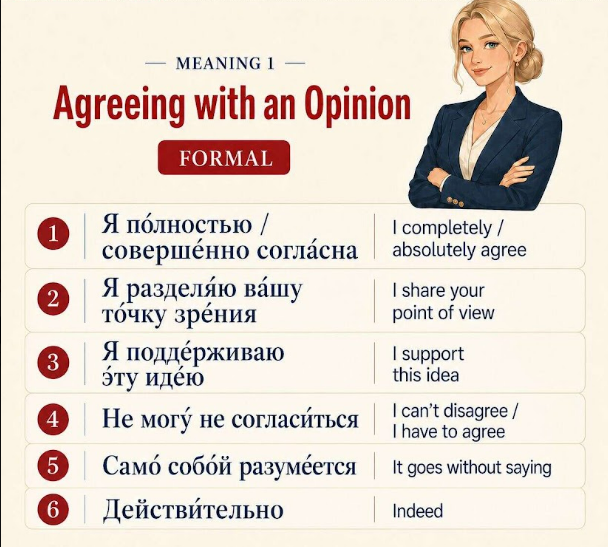
1. Я по́лностью / соверше́нно согла́сен (согла́сна).
I completely / absolutely agree.
Usage: Appropriate in professional discussions, meetings, interviews, academic contexts and polite conversation. Пóлностью is more common and neutral; соверше́нно can sound slightly more emphatic or formal.
Grammar: согласен С КЕМ? С ЧЕМ? (+ Instrumental). You can also use согла́сна С ТЕМ, ЧТО…
— Нам ну́жно пересмотре́ть э́тот план.
— Я по́лностью с ва́ми согла́сна.
— Образова́ние должно́ быть досту́пно для всех.
— Я соверше́нно согла́сна.
“We need to reconsider this plan.”
“I completely agree with you.”
“Education should be accessible to everyone.”
“I absolutely agree.”
2. Я разделя́ю ва́шу то́чку зре́ния.
I share your point of view.
Usage: More formal than simply Я согла́сна. Particularly useful in professional, political and academic discussions.
Grammar: разделя́ть ЧТО (+ Accusative): то́чку зре́ния, мне́ние, пози́цию, взгляд.
— Я счита́ю, что нам ну́жно измени́ть страте́гию.
— Я разделя́ю ва́шу то́чку зре́ния.
— Э́ту пробле́му нельзя́ реши́ть за оди́н день.
— Я по́лностью разделя́ю ва́шу то́чку зре́ния.
“I think we need to change our strategy.”
“I share your point of view.”
“This problem cannot be solved in one day.”
“I completely share your point of view.”
3. Я подде́рживаю э́ту иде́ю.
I support this idea.
Usage: This is stronger than simply agreeing. You are expressing approval or support for an idea, proposal or initiative.
Grammar: подде́рживать КОГО? ЧТО (+ Accusative).
— Я предлага́ю перенести́ встре́чу на пя́тницу.
— Я подде́рживаю э́ту иде́ю.
— Мо́жет быть, нам сто́ит сократи́ть расхо́ды?
— Я подде́рживаю э́то предложе́ние.
“I suggest rescheduling the meeting to Friday.”
“I support that idea.”
“Maybe we should reduce expenses?”
“I support that proposal.”
4. Не могу́ не согласи́ться.
I can’t disagree. / I have to agree.
Usage: A restrained, somewhat formal way of saying that the other person’s argument is convincing.
Grammar: согласи́ться с кем? с чем? (+ Instrumental). You can also use согласи́ться С ТЕМ, ЧТО …
— Э́тот вопро́с ну́жно реша́ть как мо́жно бы́стрее.
— Не могу́ с ва́ми не согласи́ться.
— Без дополни́тельных да́нных де́лать вы́воды ра́но.
— Не могу́ не согласи́ться.
“This issue needs to be resolved as quickly as possible.”
“I can’t disagree with you.”
“It’s too early to draw conclusions without additional data.”
“I have to agree.”
5. Само́ собо́й разуме́ется.
It goes without saying.
Usage: Signals that something is obvious or self-evident. Depending on intonation, it can sound polite and assured—or slightly dismissive.
Grammar: A fixed impersonal expression. It can be followed by ЧТО + clause: Само́ собо́й разуме́ется, что…
— Безопа́сность должна́ быть на пе́рвом ме́сте.
— Само́ собо́й разуме́ется.
— Мы должны́ предупреди́ть клие́нтов зара́нее.
— Само́ собо́й разуме́ется.
“Safety should come first.”
“It goes without saying.”
“We need to notify the clients in advance.”
“Of course.”
6. Действи́тельно.
Indeed.
Usage: Often confirms that the other person’s observation is correct rather than expressing enthusiastic agreement.
Grammar: An adverb used independently or within a sentence: Э́то действи́тельно так.
— Це́ны в после́днее вре́мя вы́росли.
— Действи́тельно.
— Э́та зада́ча оказа́лась сложне́е, чем мы ду́мали.
— Да, действи́тельно.
“Prices have gone up recently.”
“Indeed.”
“This task turned out to be harder than we thought.”
“Yes, indeed.”
NEUTRAL EXPRESSIONS
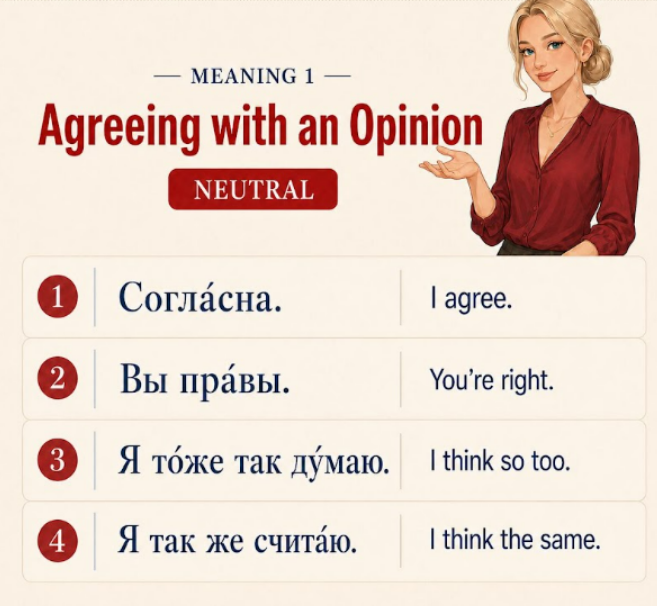
1. Согла́сна. / Согла́сен.
I agree.
This is your basic all-purpose expression. The ending agrees with the speaker’s gender: a man says согла́сен, a woman согла́сна.
Grammar: согла́сен / согла́сна С КЕМ С ЧЕМ? (+ Instrumental). You can also use согла́сна С ТЕМ, ЧТО…
— Здесь лу́чше ничего́ не меня́ть.
— Согла́сна.
— Нам ну́жно поговори́ть с ним сего́дня.
— Согла́сен.
“It’s better not to change anything here.”
“I agree.”
“We need to talk to him today.”
“I agree.”
2. Вы пра́вы. Ты пра́в/права́.
You’re right.
Usage: Neutral and polite. Use Ты прав / Ты права́ in informal conversation.
Grammar: прав for a man when using a ты-form, права́ for a woman when using a ты-form, пра́вы for plural or polite Вы.
— Э́то мо́жет заня́ть бо́льше вре́мени.
— Вы пра́вы.
— Нам на́до вы́ехать пора́ньше.
— Да, ты прав.
“This may take more time.”
“You’re right.”
“We need to leave earlier.”
“Yes, you’re right.”
3. Я то́же так ду́маю.
I think so too.
Usage: Very common, natural and neutral. It emphasizes that you independently have the same opinion.
Grammar: ду́мать, что… or ду́мать о ком? о чём?
— Мне ка́жется, фильм был сли́шком дли́нный.
— Я то́же так ду́маю.
— Э́то, наве́рное, лу́чший вариа́нт.
— Я то́же так ду́маю.
“I think the movie was too long.”
“I think so too.”
“That’s probably the best option.”
“I think so too.”
4. Я так же счита́ю.
I think the same.
Usage: Slightly more deliberate than Я то́же так ду́маю and useful when exchanging opinions.
Grammar: счита́ть, ЧТО…; when it means “consider someone/something to be” .
— Э́тот вопро́с ну́жно обсужда́ть отде́льно.
— Я так же счита́ю.
— Реше́ние бы́ло пра́вильным.
— Я так же счита́ю.
“This issue needs to be discussed separately.”
“I think the same.”
“The decision was correct.”
“That’s what I think too.”
COLLOQUIAL EXPRESSIONS
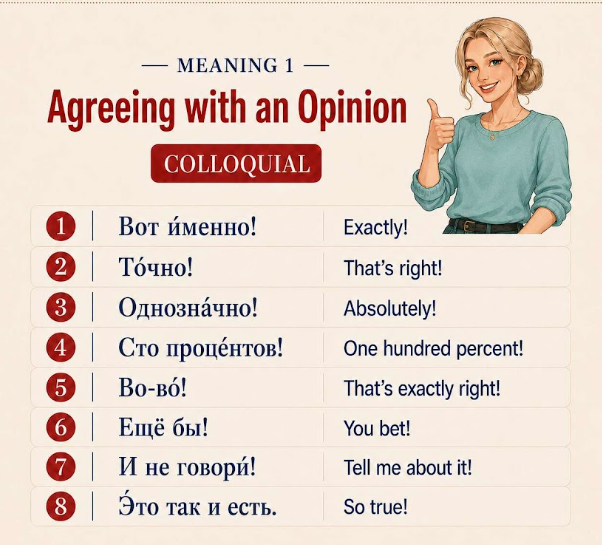
1. Вот и́менно!
Exactly!
Used when someone has expressed precisely the point you were thinking.
— Пробле́ма не в деньга́х, а во вре́мени.
— Вот и́менно!
— Он мно́го обеща́ет, но ма́ло де́лает.
— Вот и́менно!
“The problem isn’t money—it’s time.”
“Exactly!”
“He promises a lot but does very little.”
“Exactly!”
2. То́чно!
That’s right!
Short, very common and spontaneous.
— Нам ну́жно бы́ло позвони́ть зара́нее.
— То́чно!
— Она́ говори́ла, что прие́дет в суббо́ту.
— То́чно!
“We should have called ahead.”
“That’s right!”
“She said she’d come Saturday.”
“That’s right!”
3. Однозна́чно!
Absolutely!
An emphatic colloquial confirmation. Often means “definitely” rather than literally “I agree.”
— Э́тот сериа́л лу́чше пе́рвого.
— Однозна́чно!
— Туда́ сто́ит съе́здить ещё раз.
— Однозна́чно!
“This series is better than the first one.”
“Absolutely!”
“It’s worth going there again.”
“Absolutely!”
4. Сто проце́нтов!
One hundred percent!
Strong, enthusiastic agreement. Very common in informal speech.
— Она́ бы́ла лу́чшим кандида́том.
— Сто проце́нтов!
— Э́то была́ оши́бка.
— Сто проце́нтов!
“She was the best candidate.”
“One hundred percent!”
“That was a mistake.”
“One hundred percent!”
5. Во-во!
That’s exactly right!
Highly conversational. It often carries the sense of “Yes! That’s exactly what I mean.”
— Он сам не зна́ет, чего́ хо́чет.
— Во-во!
— Снача́ла на́до всё прове́рить, а пото́м реша́ть.
— Во-во!
“He doesn’t even know what he wants.”
“That’s exactly right!”
“First we need to check everything, then decide.”
“That’s exactly right!”
6. Ещё бы!
You bet!
Usage: Strong agreement when the answer seems obvious. Intonation matters.
— Ты рад, что о́тпуск начина́ется за́втра?
— Ещё бы!
— Э́тот конце́рт сто́ил того́?
— Ещё бы!
“Are you happy your vacation starts tomorrow?”
“You bet!”
“Was that concert worth it?”
“You bet!”
7. И не говори́!
Tell me about it!
Usage: Often used when agreeing with a complaint, observation or shared emotional reaction. The literal translation “Don’t even say it” is misleading.
— Ну и жа́ра сего́дня!
— И не говори́!
— Как же бы́стро пролете́ло ле́то.
— И не говори́!
“It’s so hot today!”
“Tell me about it!”
“The summer went by so quickly.”
“Tell me about it!”
8. Так и есть.
So true. (Lit. – That’s exactly how it is.)
Used to confirm that someone’s description of a situation is accurate.
— Лю́ди ча́сто недооце́нивают, ско́лько вре́мени э́то занима́ет.
— Так и есть.
— Язы́к забыва́ется, е́сли им не по́льзоваться.
— Так и есть.
“People often underestimate how much time it takes.”
“That’s exactly how it is.”
“You lose a language if you don’t use it.”
“That’s true.”
RUSSIAN SLANG FOR AGREEING
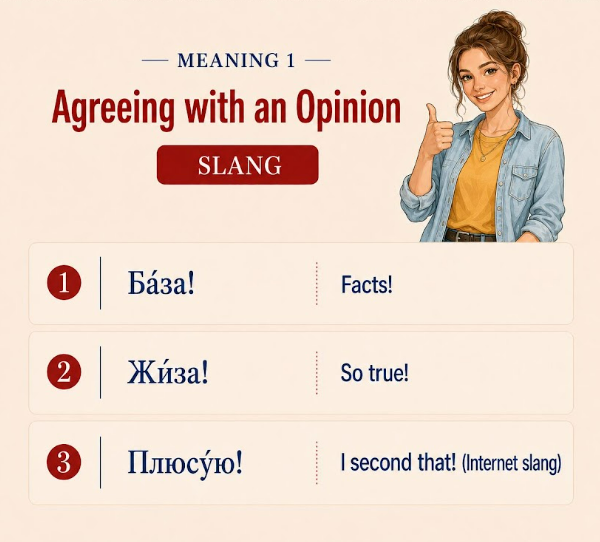
1. Ба́за!
Fact!
Modern internet and youth slang. It signals that someone has said something fundamentally correct or obvious.
Avoid it in formal or professional communication unless you are deliberately being playful.
— Спать во́семь часо́в лу́чше, чем пить пять ча́шек ко́фе.
— Ба́за!
— Без пра́ктики язы́к не вы́учишь.
— Ба́за!
“Sleeping eight hours is better than drinking five cups of coffee.”
“Fact!”
“You can’t learn a language without practice.”
“Fact!”
2. Жи́за!
So true!
Derived from жизнь. Use it when someone’s experience is painfully or humorously relatable.
— Купи́ла проду́кты на неде́лю, а де́нег бу́дто на ме́сяц потра́тила.
— Жи́за!
— Открыва́ю телефо́н на мину́тку и пропада́ю на час.
— Жи́за!
“I bought groceries for a week but somehow spent a month’s budget.”
“So true!”
“I open my phone for a minute and lose an hour.”
“So true!”
3. Плюсу́ю!
I second that!
Internet slang originally connected with giving something a “+1.” Now it can be used to endorse someone else’s statement.
Grammar: Grammatically, плюсу́ю is first-person singular: “I give this a plus / I second it.
— Предлага́ю встре́титься по́сле рабо́ты.
— Плюсу́ю!
— Лу́чше провести́ вы́ходные за го́родом.
— Плюсу́ю!
“I suggest meeting after work.”
“I second that!”
“Better to spend the weekend outside the city.”
“I’m with you on that!”
Agreeing to Do Something in Russian
Now the situation changes.
You aren’t saying that someone’s opinion is correct. You are accepting a suggestion, request, plan or arrangement.
That changes the Russian expressions considerably.
FORMAL EXPRESSIONS
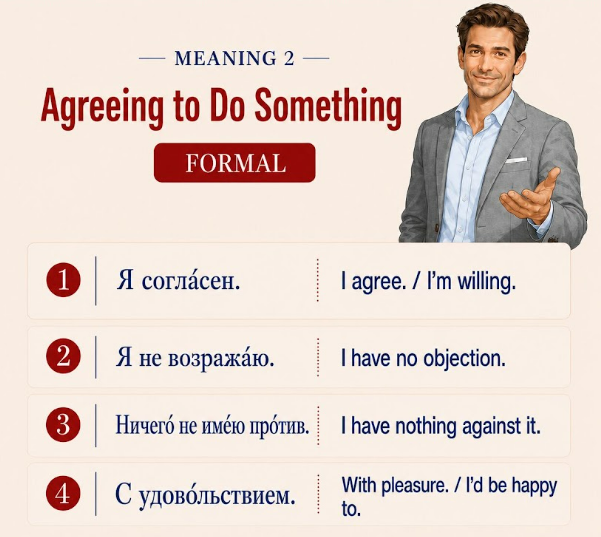
1. Я согла́сен. / Я согла́сна.
I agree. / I’m willing.
Grammar: When agreeing to an action, согла́сен / согла́сна takes the action in the form of Infinitive: Я согла́сен уча́ствовать. Less common to use an action as a noun: согла́сен НА ЧТО? (+ Accusative): согласен на участие.
— Вы согла́сны уча́ствовать в прое́кте?
— Да, я согла́сен.
— Вы согла́сны на э́ти усло́вия?
—Да, согла́сна.
“Are you willing to participate in the project?”
“Yes, I am.”
“Do you agree to these terms?”
“I do.”
2. Я не возража́ю.
I have no objection. / I don’t mind.
A restrained way of accepting a proposal rather than enthusiastically volunteering.
Grammar: возража́ть ПРОТИВ ЧЕГО? (+ Genitive); also when need to attach a clause – возража́ть ПРОТИВ ТОГО, ЧТОБЫ …
— Вы не возража́ете, е́сли мы начнём пора́ньше?
— Нет, не возража́ю.
— Мо́жем перенести́ встре́чу на пя́тницу?
— Не возража́ю.
“Do you mind if we start earlier?”
“No, I don’t.”
“Can we move the meeting to Friday?”
“I have no objection.”
3. Ничего́ не име́ю про́тив.
I have nothing against it.
Similar to Я не возража́ю, but slightly more explicit.
Grammar: име́ть про́тив КОГО? ЧЕГО? (+ Genitive).
— Вы не про́тив, е́сли мы пригласи́м А́нну?
— Ничего́ не име́ю про́тив.
— Предлага́ю оста́ться здесь ещё на оди́н день.
— Ничего́ не име́ю про́тив.
“Do you mind if we invite Anna?”
“I have nothing against it.”
“I suggest staying here another day.”
“Fine by me.”
4. С удово́льствием.
I’d be happy to. (Lit. – With pleasure).
Polite and positive. This phrase is not limited to formal Russian—it works beautifully in ordinary conversation as well.
Grammar: Literally с + instrumental: с удово́льствием. The action is often understood from context.
— Вы не могли́ бы выступи́ть на конфере́нции?
— С удово́льствием.
— Хо́чешь поу́жинать с на́ми?
— С удово́льствием!
“Would you be able to speak at the conference?”
“I’d be happy to.”
“Would you like to have dinner with us?”
“With pleasure!”
NEUTRAL EXPRESSIONS
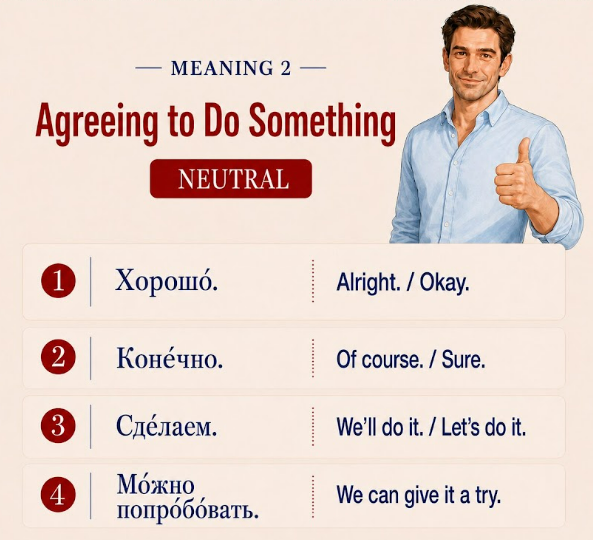
1. Хорошо́.
Alright. / Okay.
Probably one of the safest and most versatile ways to accept a request or suggestion.
— Позвони́ мне ве́чером.
— Хорошо́.
— Дава́й обсу́дим э́то за́втра.
— Хорошо́.
“Call me tonight.”
“Okay.”
“Let’s discuss it tomorrow.”
“Alright.”
2. Коне́чно.
Of course. / Sure.
Friendly and willing. Depending on intonation, it can range from polite to enthusiastic.
— Мо́жешь мне помо́чь?
— Коне́чно.
— Ты схо́дишь со мной?
— Коне́чно!
“Can you help me?”
“Of course.”
“Will you come with me?”
“Of course!”
3. Сде́лаем.
We’ll do it.
Grammar: First-person plural future form of perfective сде́лать. Russian often uses first-person plural forms to signal acceptance of a task or plan.
— На́до зако́нчить э́то до пя́тницы.
— Сде́лаем.
— Мо́жете подгото́вить отчёт к десяти утра́?
— Сде́лаем.
“We need to finish this by Friday.”
“We’ll do it.”
“Can you prepare the report by 10 am?”
“We’ll get it done.”
4. Мо́жно попро́бовать.
I/we can give it a try.
A cautious agreement. You are willing to try the suggestion without necessarily saying you believe it will succeed.
Grammar: мо́жно + infinitive is an impersonal construction: мо́жно попро́бовать, мо́жно сде́лать, мо́жно обсуди́ть.
— Дава́й пойдём друго́й дорого́й.
— Мо́жно попро́бовать.
— Мо́жет, перенесём заня́тие на у́тро?
— Мо́жно попро́бовать.
“Let’s take a different route.”
“We can give it a try.”
“Maybe we could reschedule the lesson to the morning?”
“We could try that.”
COLLOQUIAL EXPRESSIONS
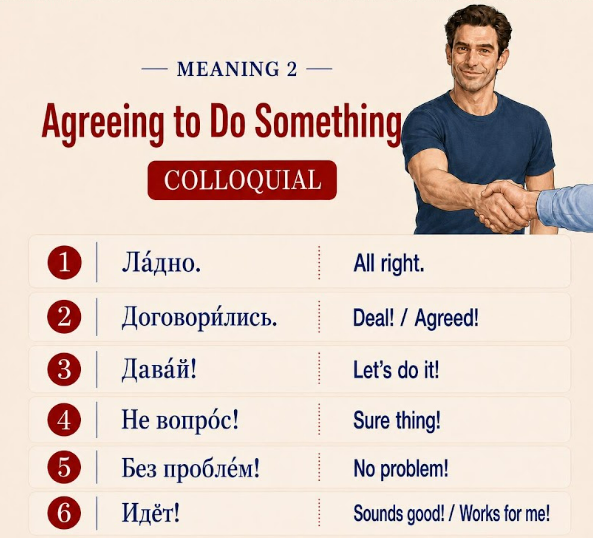
1. Ла́дно.
Alright.
Extremely common. But pay attention to intonation: Ла́дно! can sound enthusiastic, while a reluctant Ла́дно… can mean “Fine, if I have to.”
— Дава́й ещё немно́го погуля́ем.
— Ла́дно.
— Позвони́ ему сама́.
— Ла́дно, позвоню́.
“Let’s walk a little longer.”
“Alright.”
“Call him yourself.”
“Fine, I’ll call him.”
2. Договори́лись!
Deal! / Agreed!
Excellent for reaching an arrangement.
Grammar: From договори́ться С КЕМ + О ЧЁМ.
— Встре́тимся в семь?
— Договори́лись.
— Ты поку́паешь биле́ты, а я брони́рую оте́ль.
— Договори́лись!
“Meet at seven?”
“Deal.”
“You buy the tickets and I’ll book the hotel.”
“Agreed!”
3. Дава́й!
Let’s do it! / Sure!
One of the most useful colloquial Russian words.
Grammar: The most common usage of дава́й is as being a part of a мы- form Imperative when it is used together with the Perfective Future мы- form verb: Дава́й пойдём. Дава́й встре́тимся. In the colloquial meaning of agreeing, давай is used solo.
— Пойдём вы́пьем ко́фе?
— Дава́й!
— Дава́й созво́нимся ве́чером.
— Дава́й!
“Let’s go get some coffee!”
“Sure!”
“Let’s talk on the phone tonight.”
“Let’s do it!”
4. Не вопро́с!
Sure thing!
Literally “not an issue,” but do not translate it literally. It means that the request is easy or presents no problem.
— Мо́жешь забра́ть меня́ по́сле рабо́ты?
— Не вопро́с!
— Помо́жешь мне э́то перенести́?
— Не вопро́с!
“Can you pick me up after work?”
“Sure thing!”
“Will you help me move this?”
“No problem!”
5. Без пробле́м!
No problem!
Very common informal acceptance of a request.
— Пришли́ мне э́тот файл сего́дня.
— Без пробле́м!
— Мо́жешь подожда́ть пять мину́т?
— Без пробле́м.
“Send me that file today.”
“No problem!”
“Can you wait five minutes?”
“No problem.”
6. Идёт!
Sounds good! / Works for me!
A very natural colloquial way to accept a proposed time, price, plan or arrangement.
Grammar: Literally the third-person singular of идти́, but in this use Идёт! functions as a fixed colloquial response.
— Встре́тимся в шесть?
— Идёт!
— Дава́й я гото́влю, а ты убира́ешься.
— Идёт!
“Meet at six?”
“Works for me!”
“How about I cook and you clean?”
“Deal!”
RUSSIAN SLANG FOR AGREEING
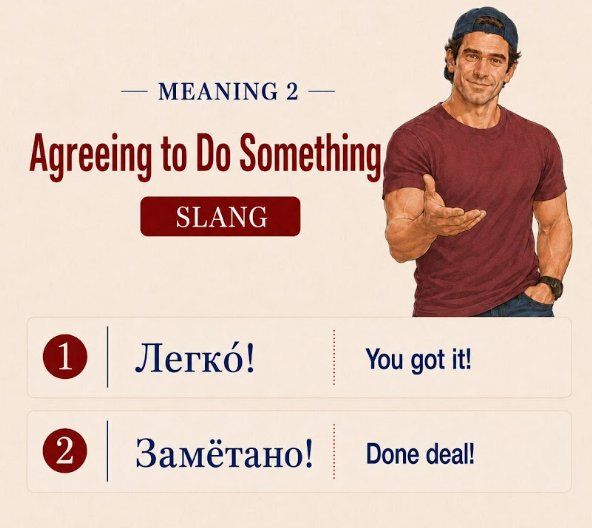
1. Легко́!
You got it! / Easy!
Very casual. It communicates not only agreement but also “Sure, that’s easy—I can do it.”
— Подбро́сишь меня́ до ме́тро?
— Легко́!
— Помо́жешь мне с э́тим за́втра?
— Легко́!
“Can you give me a ride to the metro?”
“You got it!”
“Will you help me with this tomorrow?”
“Absolutely!”
2. Замётано!
Done deal!
A lively, slangy way of saying an arrangement has been settled.
Usage: Very informal and on the edge of somewhat playful and slightly disrespectful. So you may want to avoid using it but you can understand it when Russians say it or you hear it in the movies.
— В суббо́ту е́дем за́ город?
— Замётано!
— Я беру́ еду́, ты покупа́ешь напи́тки.
— Замётано!
“We’re going out of town Saturday?”
“Done deal!”
“I’ll bring the food, you buy the drinks.”
“Deal!”
How to Choose the Right Expression?
You do not need to memorize all 37 expressions at once.
Instead, choose several from each register that fit the way you actually speak.
For example:
Agreeing with an opinion
Formal → Я по́лностью согла́сна.
Neutral → Я то́же так ду́маю.
Colloquial → Вот и́менно! / Сто проце́нтов!
Slang → Ба́за! / Жи́за!
Agreeing to do something
Formal/polite → С удово́льствием.
Neutral → Хорошо́. / Коне́чно.
Colloquial → Договори́лись! / Не вопро́с! / Идёт!
Slang → Легко́! / Замётано!
That is the real goal at the advanced level: not simply knowing how to translate “I agree,” but having enough options to choose the phrase that fits the person, situation and tone.
Because speaking naturally isn’t about finding a Russian equivalent for an English phrase.
It’s about knowing what a Russian speaker would actually say in that particular situation.
Explore more natural everyday expressions in our lesson on how to say “I’m tired” in Russian.
Want to Sound More Natural in Russian?
Maybe you know the feeling:
“I know how to say it in Russian, but I’m never sure if that’s how Russians actually say it.”
Or:
“I understand Russian pretty well, but when I speak, I keep using the same basic words and phrases.”
That’s exactly what the METRO: Conversational Russian books are designed to help with.
METRO takes you beyond textbook Russian and teaches you the vocabulary, everyday expressions, colloquial language, and sentence patterns you need to talk naturally about real life—from your home and daily routine to food, travel, family, work, health, and more.
Each book combines Russian in context with audio and structured practice, so you don’t just learn new expressions—you learn to recognize them when Russians use them and actually use them yourself.
👉 Explore the METRO: Conversational Russian book series on Amazon and start moving from “I know Russian” to “I can actually say what I want to say.”