
- in Uncategorized by Marina Koker
Say It Like a Russian: What Should You Call a Russian Person?
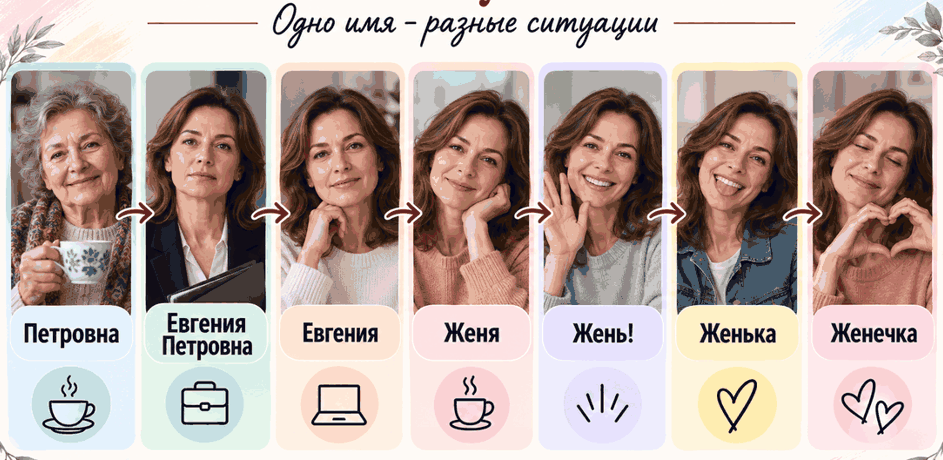
If you are learning Russian, knowing someone’s name is not enough.
You also need to know which form of that name to use.
The same person might be called:
Евге́ния Петро́вна → Евге́ния → Же́ня → Жень → Же́нька → Же́нечка
And these are not simply different versions of the same name.
Each one tells you something about the situation and the relationship between the speakers: formality, social distance, familiarity, affection — and sometimes attitude.
So, what should you actually call a Russian person?
Let’s look at how the system works.
1. Full Name: First Name + Patronymic + Last Name
И́мя + о́тчество + фами́лия
You most likely already know that a Russian full personal name traditionally consists of three parts:
и́мя + о́тчество + фами́лия
first name + patronymic + last name
For example:
Евге́ния Петро́вна Смирно́ва
Андре́й Ива́нович Петро́в
The о́тчество (patronymic) is normally formed from the father’s first name.
Пётр → Петро́вич / Петро́вна
Ива́н → Ива́нович / Ива́новна
Серге́й → Серге́евич / Серге́евна
The three-part name is primarily an official identification form. You will see it in documents, records, applications, official lists, and other administrative contexts.
But when Russians actually address someone respectfully, they normally do not use all three parts.
They use the next form.
2. First Name + Patronymic
Евге́ния Петро́вна
Андре́й Ива́нович
This is one of the most important forms of address in Russian culture.
It communicates respect and formality.
A Russian speaker may use first name + patronymic when speaking to:
- someone considerably older: an older colleague, neighbor, or family acquaintance;
- someone in a position of authority: a professor or teacher; a supervisor or someone in a position of authority; a doctor; a government official;
- someone with whom they have a formal or professionally respectful relationship.
For example:
Евге́ния Петро́вна, мо́жно зада́ть вопро́с?
Evgenia Petrovna, may I ask you a question?
Андре́й Ива́нович, вы уже́ ви́дели докуме́нты?
Andrei Ivanovich, have you seen the documents yet?
This form always goes together with Вы, never with ты.
For English speakers, this is often one of the least familiar parts of Russian naming culture.
Евге́ния Петро́вна is not simply the person’s “longer name.” It is a conventional Russian way of expressing respectful social distance.
The Introduction Rule
Pay close attention to how a Russian person introduces themselves to you.
If someone introduces herself as:
— Наде́жда Никола́евна.
that is a strong signal that this is the form she expects you to use.
Your safest response is:
— Рад знако́мству, Наде́жда Никола́евна. Меня́ зову́т Стив.
Nice to meet you, Nadezhda Nikolaevna. My name is Steve.
Do not immediately shorten Наде́жда Никола́евна to Наде́жда or На́дя.
Let the Russian speaker shorten the distance first.
What about Russians living in the West?
Older Russians who have lived in the United States or another Western country for a long time may introduce themselves using only their first name.
If you are unsure whether they would prefer a patronymic, you can simply ask:
А как Вас по о́тчеству?
And what is your patronymic?
For example:
— Меня́ зову́т Валенти́н. Я Ваш сосе́д.
My name is Valentin. I’m your neighbor.
— О́чень прия́тно, Валенти́н. А как Вас по о́тчеству?
Very nice to meet you, Valentin. And what is your patronymic?
He might answer:
— Да не на́до о́тчества. Мы же в Аме́рике живём. Мо́жно про́сто Валенти́н.
No need for the patronymic. We live in America. Just call me Valentin.
Or:
— Валенти́н Алексе́евич.
Valentin Alexeyevich.
Now you know which form he prefers.
3. Patronymic Only: Петро́вна, Ива́нович…
Here is a form of address that often surprises learners of Russian:
Sometimes Russians call a person by their patronymic only.
Евге́ния Петро́вна → Петро́вна
Андре́й Ива́нович → Ива́нович
But this does not make the relationship more formal.
Quite the opposite.
Using the patronymic alone is traditionally associated with informal, familiar communication, especially among older Russians who know each other well.
You may hear it between longtime neighbors, old friends, coworkers who have known each other for many years, people in a small town or village, or older people chatting informally with one another.
For example:
— Петро́вна, ты куда́?
Petrovna, where are you going?
— Ива́нович, заходи́ чай пить!
Ivanovich, come in for some tea!
— Ну что, Серге́евна, как дела́?
So, Sergeyevna, how are things?
Notice something interesting:
Евге́ния Петро́вна + Вы express respect and social distance.
But:
Петро́вна + ты express familiarity and long-standing personal closeness.
The same patronymic is involved — but the social meaning is completely different.
What does Петро́вна sound like?
This form often has a distinctly traditional, down-to-earth, conversational flavor. It can create a feeling of familiarity: We have known each other forever. We don’t need formalities.
It is particularly characteristic of older generations and traditional social environments. You may hear it less often among younger urban Russians, but it remains an important form to recognize because it appears in everyday speech, films, TV series, literature, and conversations between older speakers.
And it is not limited to women:
Петро́вич, Ива́нович, Серге́ич and other male patronymics can be used in the same way.
Should a learner use this form?
Usually, not immediately.
Even if you hear other people calling a woman Петро́вна, that does not automatically give you permission to do the same.
This form assumes a certain kind of familiarity and shared social relationship.
The safest rule is the same one we have already seen:
Recognize it first. Use it only when you are clearly part of a relationship in which this form is natural.
4. Full First Names: Евгения, Дмитрий…
A full first name without a patronymic is common in introductions, professional communication, official and semi-formal situations, and whenever the person prefers the full form of their name.
Андре́й, Вы сейча́с свобо́дны?
Andrei, are you available right now?
Познако́мьтесь, э́то Алекса́ндр.
Meet Alexander.
In modern Russian professional communication, using a full first name without a patronymic is increasingly common:
Евге́ния, до́брый день!
It sounds polite and professional, but creates less social distance than:
Евге́ния Петро́вна, до́брый день!
Again, remember the Introduction Rule.
If someone introduces herself as Евге́ния, call her Евге́ния.
Do not automatically turn it into Же́ня.
Wait until she says something like:
Мо́жно про́сто Же́ня.
You can just call me Zhenya.
That one sentence changes the relationship.
5. Short Names: Ма́ша, Же́ня, Ка́тя…
Most Russian first names have not only a full form but also one or more short forms — what English speakers often think of as nicknames.
For example:
Алекса́ндр /Алекса́ндра → Са́ша / Са́ня / Шу́ра
Екатери́на → Ка́тя
Евге́ний / Евге́ния → Же́ня
Short names are extremely important in everyday Russian.
They are used among friends, family members, classmates, close colleagues, and people who have established an informal relationship.
They normally go together with ты, although in some professional environments you may also hear a short name used with Вы.
But Russian short names can be confusing
First, the connection between the full and short name is not always obvious.
How would a learner guess that:
Алекса́ндр → Са́ша
Михаил → Ми́ша
Влади́мир → Во́ва / Воло́дя
Никола́й → Ко́ля?
You often simply have to learn them.
Second, many Russian short names — including male names — end in -а / -я.
Compare:
Ва́ня — male → Ива́н
Та́ня — female → Татья́на
А́ня — female → Анна
Лёня — male → Леони́д
Се́ня — male → Арсе́ний
And some short names can belong to both, a man and a woman:
Же́ня → Евге́ний / Евге́ния
Са́ша, Са́ня → Алекса́ндр / Алекса́ндра
Ва́ля → Валенти́н/ Валенти́на
So if someone messages you:
Меня́ зову́т Же́ня.
you may not know whether you are talking to a man or a woman.
There is also an important grammatical consequence.
Short names ending in -а / -я decline like nouns such as ма́ма, even when the person is male.
Compare:
Я зна́ю Алекса́ндра. → Я зна́ю Са́шу.
I know Alexander. → I know Sasha.
Ты позвони́ла Никола́ю? → Ты позвони́ла Ко́ле?
Did you call Nikolai? → Did you call Kolya?
Some common Russian names
| Full name | Common short form(s) |
| Алекса́ндр / Алекса́ндра | Са́ша; Са́ня; Шу́ра |
| Алексе́й | Алёша, Лёша |
| Дми́трий | Ди́ма, Ми́тя |
| Евге́ний / Евге́ния | Же́ня |
| Ива́н | Ва́ня |
| Макси́м | Макс |
| Михаил | Ми́ша |
| Никола́й | Ко́ля |
| Па́вел | Па́ша |
| Серге́й | Серёжа |
| Влади́мир | Во́ва, Воло́дя |
| Анастаси́я | На́стя |
| Анна | А́ня |
| Екатери́на | Ка́тя |
| Еле́на | Ле́на |
| Ири́на | И́ра |
| Мари́я | Ма́ша |
| Ната́лья | Ната́ша |
| О́льга | О́ля |
| Светла́на | Све́та |
| Татья́на | Та́ня |
Not every Russian name has a standard neutral short form. Names such as Мари́на, Ни́на, Ве́ра, Андре́й, Анто́н, И́горь and Марк may be used in their full form even in informal communication.
But that does not mean that these names cannot change.
They can.
6. One Name — Different Relationships
Once Russians begin using an informal name, the name can change again.
Compare:
Же́ня → Жень → Же́нька → Же́нечка
These forms are not interchangeable.
Each communicates something different.
A. Informal Forms of Direct Address: Жень! Тань! Саш!
Listen to Russians speaking casually and you will constantly hear forms such as:
Жень!
Тань!
Кать!
Саш!
Серёж!
These forms are sometimes described as a modern Russian vocative-like form.
They appear when Russians are:
- speaking informally, and
- directly addressing the person.
They are used with male and female short names ending in -а / -я:
Ми́ша, Ви́тя, Лю́ся, Ле́на
and also with some women’s full names that do not have a standard short form:
Мари́на, Ве́ра, Ни́на
How is the form created?
With names ending in -а / -я, the final vowel disappears:
Са́ша → Саш!
Ни́на → Нин!
Серёжа → Серёж!
Же́ня → Жень!
Та́ня → Тань!
Ка́тя → Кать!
You will hear sentences like:
Жень, ты во ско́лько придёшь?
Zhenya, what time are you coming?
Тань, извини́, у меня́ нет вре́мени.
Tanya, sorry, I don’t have time.
Кать, позвони́ мне за́втра ве́чером.
Katya, call me tomorrow evening.
Спаси́бо тебе́, Саш!
Thank you, Sasha!
Нин, а где у нас лежа́т салфе́тки?
Nina, where do we keep the napkins?
Серёж, дава́й поговори́м.
Seryozha, let’s talk.
These forms are not “young people’s Russian.” They are a normal feature of informal spoken Russian and can be used by speakers of different ages.
Important: Use These Forms Only with People You Address as ты
Please note that these forms can be used only with someone you address as ты.
As mentioned above, a short name can sometimes be used with someone you address as Вы. However, the shortened direct-address forms — Маш, Жень, Тань, Саш — belong specifically to informal ты communication.
So, you cannot use one of these forms with someone you normally address as Вы without suddenly — and quite noticeably — switching to a much more informal level of communication. If you do, don’t be surprised if the person gives you a surprised look!
For example:
You have a colleague named Мари́я. She introduced herself to you as Ма́ша, so that is what you call her. You are friendly colleagues, but not close friends, and you still address each other as Вы.
When you speak directly to her, call her Ма́ша, not Маш.
Correct:
— Ма́ша, Вы не зна́ете, где письмо́ от партнёров?
Masha, do you know where the letter from our partners is?
Incorrect:
— Маш, Вы не зна́ете, где письмо́ от партнёров?
The combination Маш + Вы sounds inconsistent: Маш signals a distinctly informal relationship, while Вы maintains social distance.
So remember:
Ма́ша + Вы ✓
Ма́ша + ты ✓
Маш + ты ✓
Маш + Вы ✗
B. Familiar Forms with -ка: Же́нька, Та́нька, Са́шка…
Now things have become more culturally complicated.
Russian also has highly informal forms with -ка:
Же́ня → Же́нька
Та́ня → Та́нька
Ка́тя → Ка́тька
Са́ша → Са́шка
Ди́ма → Ди́мка
Ми́ша → Ми́шка
Depending on the relationship, intonation, name, and situation, these forms can sound:
friendly and teasing — “We’re close; we don’t need any ceremony.”
or
dismissive, disrespectful, or even rude — “I don’t particularly respect this person.”
Among close friends, you may naturally hear:
А Же́нька сего́дня придёт?
Is Zhenka coming today?
But use the same kind of form with the wrong person and the effect can be completely different.
There is another complication: individual names do not all behave exactly alike. Some -ка forms are very natural between friends, while others can acquire a much rougher or more dismissive coloring.
That is why there is a simple rule for Russian learners:
Learn to recognize these forms — but be VERY cautious about using them yourself.
Your dictionary cannot tell you whether Же́нька in a particular conversation means “my good old friend Zhenya,” “that Zhenya,” or something in between.
The relationship, context, facial expression, and intonation tell you that.
6. Affectionate Names: Же́нечка, Катю́ша, Са́шенька…
Now we reach one of the richest parts of the Russian naming system.
Russian uses a large number of diminutive and affectionate suffixes to express warmth, tenderness, closeness, and love.
-очк-
Ле́на → Ле́ночка
Ири́на → Ири́ночка
Ве́ра → Ве́рочка
Во́ва → Во́вочка
-ечк-
Же́ня → Же́нечка
Та́ня → Та́нечка
Са́ня → Са́нечка
А́ня → А́нечка
О́ля → О́лечка
-еньк-
Ка́тя → Ка́тенька
О́ля → О́ленька
На́дя → На́денька
Ми́ша → Ми́шенька
Воло́дя → Воло́денька
This pattern is also especially productive with names ending in -ша / -жа:
Са́ша → Са́шенька
Алёша → Алёшенька
Ма́ша → Ма́шенька
Ната́ша → Ната́шенька
Андрю́ша → Андрю́шенька
Серёжа → Серёженька
-юш-
Ка́тя → Катю́ша
На́дя → Надю́ша
На́стя → Настю́ша
Ва́ня → Ваню́ша
-ушк- / -юшк-
Ю́ля → Ю́люшка
Тёма → Тёмушка
Са́ня → Саню́шка
-ик
Some male names also have familiar forms in -ик:
То́ля → То́лик
Вита́лий → Вита́лик
Во́ва → Во́вик
-ёк
Some male names have forms in stressed -ёк:
Са́ня → Санёк
Ви́тя → Витёк
-чик
You may also hear:
Арту́р → Арту́рчик
Артём → Артёмчик
But there is an important warning here:
These suffixes are not mechanically interchangeable.
You cannot learn a list of suffixes and simply attach whichever one you like to any Russian name.
Native speakers learn these forms as conventional variants of individual names.
Affectionate forms are especially common between romantic partners, parents and children, grandparents and grandchildren, relatives, and close friends.
And again, age is not the determining factor.
A woman can be Же́нечка at five, forty-five, or seventy-five.
What matters is who is speaking to her — and what relationship they have.
The same form can also change its effect according to context. Calling an adult colleague Ка́тенька may sound genuinely warm in one relationship and patronizing or inappropriate in another.
So, What Should You Call Someone?
The safest rule is surprisingly simple:
Listen to how the person introduces themselves.
If they say:
Меня́ зову́т Евге́ния Петро́вна.
use:
Евге́ния Петро́вна.
If they say:
Меня́ зову́т Евге́ния.
use:
Евге́ния.
And if they tell you:
Мо́жно про́сто Же́ня.
now you know that Же́ня is appropriate.
But when you hear someone else call the same woman:
Жень!
Же́нька!
Же́нечка!
don’t assume that you can automatically do the same.
Those names tell you something about their relationship.
And that is the larger lesson.
In Russian, a name does much more than identify a person.
It tells you how people relate to each other.
Coming soon: The Russian Names Guide
Евге́ния → Же́ня → Жень → Же́нька → Же́нечка
But what about Алекса́ндр, Дми́трий, Михаил, Екатери́на, Ната́лья, Анастаси́я — and dozens of other Russian names?
I’m preparing a practical Russian Names Guide that will bring the most common Russian names and their everyday variants together in one place.
You’ll be able to see at a glance:
Full Name → Short Name → Direct Address → Familiar Form → Affectionate Form
So the next time you hear a Russian call someone Саш, Са́шка, Са́шенька, Ми́шенька, Кать or Ната́шенька, you’ll know not only whose name it is — but what that particular form communicates.