
- in Uncategorized by Marina Koker
Say It Like a Russian: 10 Everyday Reactions
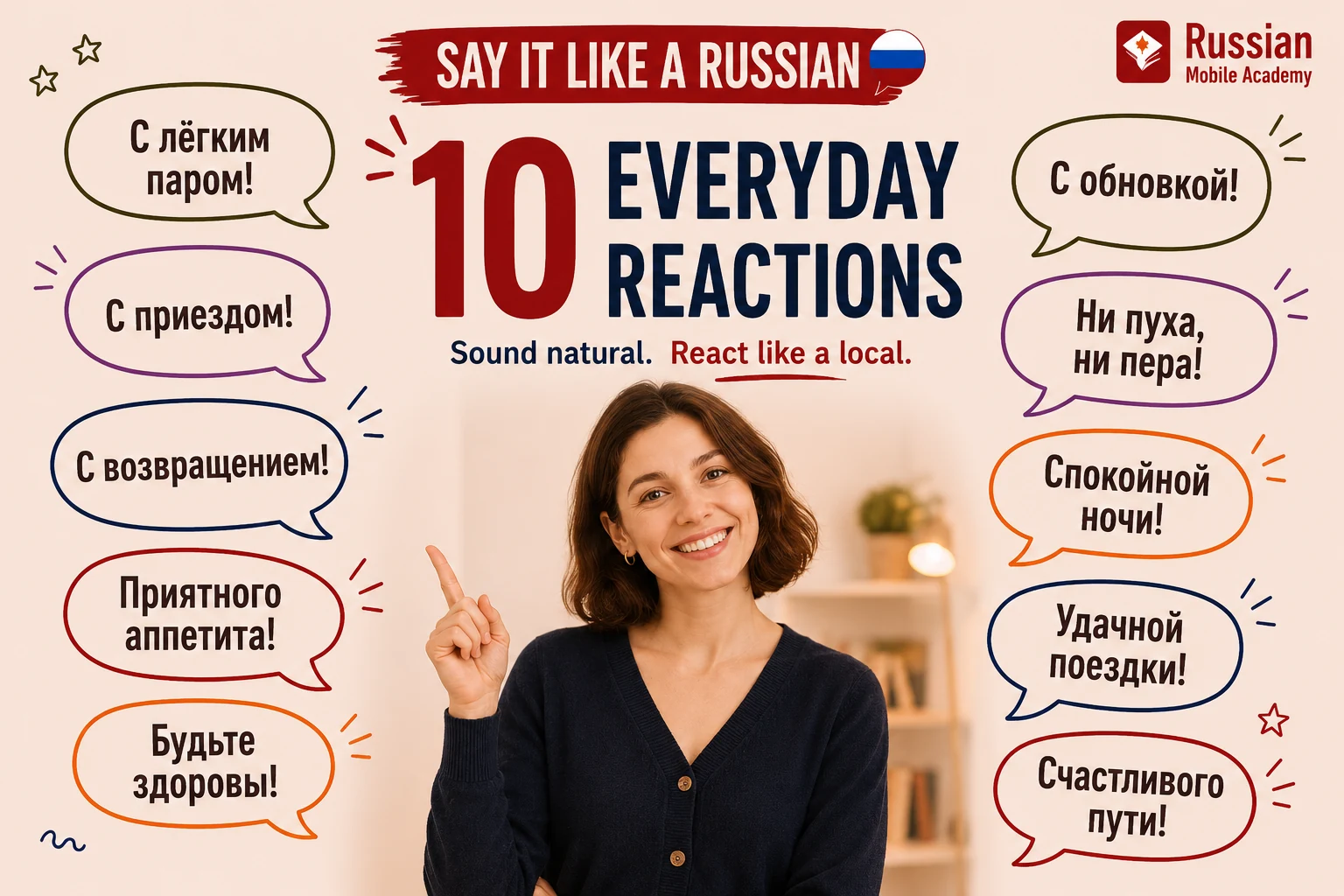
10 phrases Russian use in everyday situations
Some Russian expressions are difficult to translate — not because the words themselves are difficult, but because English speakers may not say anything at all in the same situation.
Someone arrives after traveling. Someone returns to work after being away. Someone gets out of the shower. Someone starts eating. Someone sneezes. Someone is about to leave on a trip.
For a Russian speaker, many of these situations automatically trigger a particular phrase.
These are speech rituals: conventional phrases connected to specific everyday situations. To sound natural in Russian, you need to know not only what the phrase means, but also when Russians expect to hear it — and how to respond.
Let’s look at ten of the most useful ones.

1. С прие́здом!
Welcome!
You can also include the person you are addressing:
C прие́здом тебя! Welcome! — informal
С прие́здом вас! Welcome! — formal or plural
When do Russians say it?
С прие́здом! is used in two main situations.
1. Someone arrives in a new place and is met there.
For example, you fly to Moscow to visit friends. They meet you at the airport and say:
С прие́здом!
You have arrived in Moscow, even though Moscow is not your home and you have not “returned” there.
2. Someone returns to their home city or another familiar place after traveling.
For example, your friend comes home after a vacation or after visiting relatives in another city. You can greet them with:
С прие́здом!
The important idea behind прие́зд is travel.
С прие́здом! normally implies that the person е́здил / е́здила somewhere — they traveled some distance using transportation such as a train, plane, bus, or car.
What do you say back?
Спаси́бо!
Mini-dialogue
Your friend arrives in Moscow to visit you:
— Ну наконе́ц-то! С прие́здом! Finally! Welcome!
— Спаси́бо! Как же я рад тебя́ ви́деть! Thanks! I’m so happy to see you!

2. С возвраще́нием!
Welcome back!
C возвраще́нием тебя! Welcome back! — informal
С возвраще́нием вас! Welcome back! — formal or plural
When do Russians say it?
There is one essential idea in С возвраще́нием!:
BACK.
The person was here before, left or was absent, and has now returned.
Therefore, unlike С прие́здом!, С возвраще́нием! is never used when someone arrives in a new place for the first time.
At the same time, С возвраще́нием! does not necessarily imply travel.
You can say it when:
- a coworker returns to work after being sick;
- someone returns after taking several days off;
- a colleague comes back after a vacation;
- someone returns to their former workplace after working for another company;
- someone returns to a group, project, class, or activity after an absence.
So compare:
С прие́здом! → arrival after travel
С возвраще́нием! → return to a place, group, activity, etc.
Sometimes both expressions are possible.
If your friend returns home after a vacation:
С прие́здом!
You are focusing on their arrival after a trip.
С возвраще́нием!
You are focusing on the fact that they are back.
But if your coworker returns to the office after being sick:
С возвраще́нием! ✓
С прие́здом! ✗
What do you say back?
Спаси́бо!
Mini-dialogue
— О, ты уже́ на рабо́те! С возвраще́нием! Как себя́ чу́вствуешь? Попра́вилась?
— Спаси́бо! Уже́ намно́го лу́чше.
— Oh, you’re back at work! Welcome back! How are you feeling? Are you feeling better?
— Thanks! Much better now.

3. С лёгким па́ром!
This is one of those Russian expressions that often surprises learners.
When do Russians say it?
Traditionally, С лёгким па́ром! is said to someone after a Russian bathhouse — ба́ня.
But in everyday modern Russian, family members and friends may also say it when someone comes out of the shower or took a bath.
There is no natural English equivalent. The closest one is probably “Hope you feel refreshed!”.
Depending on the context, you might loosely translate it as:
You can also add a person:
C лёгким па́ром тебя!
С лёгким па́ром вас!
What do you say back?
Спаси́бо!
Mini-dialogue
— О, ты уже́ из ду́ша? С лёгким па́ром!
— Спаси́бо!
— Oh, done with your shower? Hope you feel refreshed!
— Thanks!

4. Прия́тного аппети́та!
Enjoy your meal! Bon appetite!
When do Russians say it?
The obvious situation is before a meal.
But there is another very common Russian social situation that learners need to know.
Imagine that you walk through your workplace cafeteria and see a colleague eating lunch. Or you pass a coworker who is eating at their desk.
It is customary to acknowledge the person who is eating by saying: Прия́тного аппети́та!
Simply walking silently past a colleague who is eating can feel almost impolite — especially if you have made eye contact or are close enough that silently ignoring each other would feel unnatural.
In Russian social interaction, Прия́тного аппети́та! provides an easy, conventional way to acknowledge the person rather than simply walking past without saying anything.
You may also hear:
Прия́тного тебе́ аппети́та!
Прия́тного вам аппети́та!
These forms are grammatically possible, although the shorter Прия́тного аппети́та! is much more common.
What do you say back?
This depends on whether the other person is also eating.
Situation 1: You are about to eat together
— Прия́тного аппети́та! Enjoy your meal!
— Спаси́бо! Тебе́ (Вам) то́же! Thanks! You too!
Situation 2: You are eating, but the other person is only passing by
A colleague walks past your table in the cafeteria:
— Прия́тного аппети́та!
— Спаси́бо!
You do not normally answer Тебе́ то́же!, because the other person is not eating.
This is a small distinction, but it is exactly the kind of distinction that makes your Russian sound socially natural.

5. Будь здоро́в! / Будь здоро́ва! / Бу́дьте здоро́вы!
Bless you!
When do Russians say it?
When someone sneezes.
To a man (informal): Будь здоро́в!
To a woman (informal): Будь здоро́ва!
Formally or to several people: Бу́дьте здоро́вы!
English normally uses “Bless you!”, while Russian literally tells the person to “be healthy.”
One important cultural distinction:
Будь(те) здоро́в(ы)! is said after someone sneezes — not after someone coughs.
If someone coughs, Будь здоро́в! is not the conventional response.
What do you say back?
Спаси́бо!
Mini-dialogue
— Апчхи́!
— Будь здоро́в!
— Спаси́бо!
— Achoo!
— Bless you!
— Thanks!
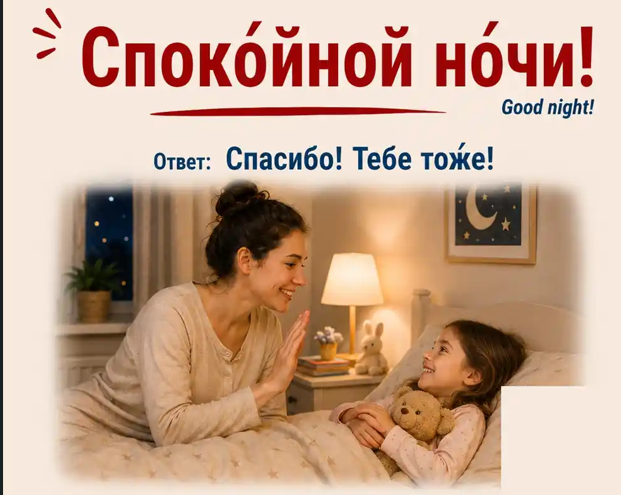
6. Споко́йной но́чи!
Good night!
When do Russians say it?
Споко́йной но́чи! is connected to sleep, not simply to the fact that it is evening.
There are two main situations.
Situation 1: At home
A family member is going to bed, and you say goodbye for the night: Споко́йной но́чи!
Situation 2: A late-night goodbye
You are not necessarily in the same house.
Close friends or family members may say Споко́йной но́чи! when saying goodbye very late in the evening — in person or at the end of a phone conversation — when it is understood that bedtime is approaching.
For example:
— Ла́дно, уже́ по́здно. Поговори́м за́втра. Споко́йной но́чи!
— И тебе́!
— All right, it’s late. Let’s talk tomorrow. Good night!
— You too!
This is different from using Good night simply as a formal nighttime equivalent of “Goodbye.”
You can also make the recipient explicit:
Споко́йной тебе́ но́чи!
Споко́йной вам но́чи!
What do you say back?
Спаси́бо, и тебе́!
И тебе́!
or formally:
Спаси́бо, и вам!
И вам!
Mini-dialogue
— Я пошёл спать. Споко́йной но́чи!
— И тебе́! До за́втра.
— I’m going to bed. Good night!
— You too! See you tomorrow.

7. Счастли́вого пути́!
Safe travels! / Have a safe trip!
When do Russians say it?
Say Счастли́вого пути́! when someone is leaving on a trip or beginning a journey.
You can also say:
Счастли́вого тебе́ пути́!
Счастли́вого вам пути́!
What do you say back?
Спаси́бо!
Mini-dialogue
— Ну всё, мне пора́ в аэропо́рт.
— Счастли́вого пути́! Не забудь позвонить, когда доедешь.
— Спаси́бо! Не забуду.
— Well, I need to head to the airport.
— Have a safe trip! Don’t forget to call when you’ll get there.
— Thanks! I won’t.

8. Уда́чной пое́здки!
Have a great trip!
When do Russians say it?
This is another common wish before someone travels.
You can also say:
Уда́чной тебе́ пое́здки!
Уда́чной вам пое́здки!
Compared with Счастли́вого пути́!, this expression focuses more broadly on the whole trip rather than just the journey itself, and it usually can be said not just immediately before taking off to the trip but some time in advance – when someone told you that s/he is going to the trip.
What do you say back?
Спаси́бо!
Mini-dialogue
— За́втра лечу́ в Петербу́рг на неде́лю.
— Здо́рово! Уда́чной пое́здки!
— Спаси́бо!
— I’m flying to St. Petersburg tomorrow for a week.
— Cool! Have a great trip!
— Thanks!

9. Ни пу́ха ни пера́!
Break a leg! Good luck!
When do Russians say it?
Before an exam, interview, competition, performance, or another situation where someone needs luck, you may hear:
Ни пу́ха ни пера́!
Literally: “Neither fur nor feather!”
Its actual meaning is: Good luck! It is similar in function to English “Break a leg!”: the literal words do not express the positive wish directly.
You can also make the recipient explicit:
Ни пу́ха тебе́ ни пера́!
Ни пу́ха вам ни пера́!
What do you say back?
This expression has its own conventional response: К чёрту! To hell with it!
Not Спаси́бо!
The traditional exchange should therefore be learned as one speech ritual:
Ни пу́ха ни пера́! — К чёрту!
Mini-dialogue
— Ну всё, я пошла́ на экза́мен.
— Ни пу́ха ни пера́!
— К чёрту!
— Okay, I’m off to my exam.
— Good luck!
— [Traditional response: “To hell with it!”]

10. С обно́вкой!
Congrats on the new outfit! Nice __!
When do Russians say it?
Someone bought a new outfit (a blouse, a dress, a sweater, new shoes, a new bag, or another new possession.
Russian has a convenient word for a newly acquired outfit item:
обно́вка
And that gives us: С обно́вкой!
There is no single natural English equivalent. Depending on the situation:
“Congrats on the new ___!” or “Nice ___!”
You can also say:
С обно́вкой тебя! С обно́вкой Вас!
What do you say back?
Спаси́бо!
Mini-dialogue
— О, у тебя́ но́вая ку́ртка? С обно́вкой!
— Спаси́бо! Вчера́ купи́ла.
— Oh, is that a new jacket? Nice!
— Thanks! I bought it yesterday.
The Grammar Behind These Expressions
These ten expressions are easier to remember if you understand the grammatical patterns behind them.
Pattern 1: С + Instrumental
Look at these expressions:
С прие́здом!
С возвраще́нием!
С лёгким па́ром!
С обно́вкой!
They can be understood as shortened versions of a construction with:
Поздравля́ю тебя́/вас с + Instrumental
For example:
С прие́здом!
← Поздравля́ю тебя́ с прие́здом!
С возвраще́нием!
← Поздравля́ю вас с возвраще́нием!
С лёгким па́ром!
← Поздравля́ю тебя́ с лёгким па́ром!
С обно́вкой!
← Поздравля́ю вас с обно́вкой!
When we explicitly include the person, we use: тебя́ / вас
Why?
поздравля́ть КОГО? (+ С ЧЕМ?)
Поздравля́ю тебя́ (с днем рождения). I congratulate you. Happy birthday!
Поздравля́ю Вас (c Рождеством). I congratulate you. Merry Christmas!
So remember the model:
ТЕБЯ́ / ВАС + С + INSTRUMENTAL
С прие́здом тебя!
С возвраще́нием Вас!
С лёгким па́ром тебя!
С обно́вкой Вас!
Pattern 2: Wishes
Now compare:
Прия́тного аппети́та!
Споко́йной но́чи!
Счастли́вого пути́!
Уда́чной пое́здки!
These expressions use the Genitive case because they can be understood as shortened versions of:
Жела́ю тебе́/вам + Genitive
For example:
Прия́тного аппети́та!
← Жела́ю тебе́ прия́тного аппети́та.
Споко́йной но́чи!
← Жела́ю вам споко́йной но́чи.
Счастли́вого пути́!
← Жела́ю тебе́ счастли́вого пути́.
Уда́чной пое́здки!
← Жела́ю вам уда́чной пое́здки.
The recipient of the wish is in the Dative: тебе́ / вам, and the actual wish is in Genitive
ЖЕЛАТЬ КОМУ?– Dative (recipient)
Жела́ю тебе́… I wish you…
Жела́ю вам…I wish you…
ЖЕЛАТЬ ЧЕГО? – Genitive (wish)
Жела́ю удачи! I wish one luck!
So the model of these phrases is: (ЖЕЛА́Ю КОМУ) + ЧЕГО:
→ Прия́тного аппети́та!
→ Споко́йной но́чи!
→ Счастли́вого пути́!
→ Уда́чной пое́здки!
What about Ни пу́ха ни пера́?
Ни пу́ха ни пера́! also belongs conceptually with wishes.
It is a fixed, idiomatic way of wishing someone good luck.
The person receiving the wish can be expressed in the Dative:
Ни пу́ха тебе ни пера́! Ни пу́ха ни пера́ тебе!
Ни пу́ха вам ни пера́! Ни пу́ха ни пера́ вам!
The nouns are also in the Genitive:
пу́ха, пера́
But unlike the transparent wishes above, you should learn Ни пу́ха ни пера́! as a fixed idiomatic expression together with its conventional response:
Ни пу́ха ни пера́! — К чёрту!
Pattern 3: A Strong Wish in the Imperative
Будь здоро́в!
Будь здоро́ва!
Бу́дьте здоро́вы!
follows a different grammatical model.
будь / бу́дьте is the Imperative of быть — “to be.”
Literally:
Будь здоро́в! Бу́дьте здоро́вы! Be healthy!
The Imperative makes this sound like a very strong, direct wish for good health.
In this particular speech ritual, however, the expression is conventionally triggered by one specific event:
someone sneezes.
So learn the complete exchange:
— Апчхи́!
— Будь здоро́в!
— Спаси́бо!
Quick Reference: Situation → Phrase → Response
| What happened? | What do you say? | Expected response |
| Someone arrives after traveling | С прие́здом! | Спаси́бо! |
| Someone returns after an absence | С возвраще́нием! | Спаси́бо! |
| Someone comes out of the bath/shower | С лёгким па́ром! | Спаси́бо! |
| Someone is eating; you are not | Прия́тного аппети́та! | Спаси́бо! |
| You are about to eat together | Прия́тного аппети́та! | Спаси́бо! Тебе́/вам то́же! |
| Someone sneezes | Будь здоро́в! / Будь здорова́! / Бу́дьте здоро́вы! | Спаси́бо! |
| Someone is going to bed / you say a very late goodbye | Споко́йной но́чи! | И тебе́/вам (тоже)! |
| Someone is beginning a journey | Счастли́вого пути́! | Спаси́бо! |
| Someone is going on a trip | Уда́чной пое́здки! | Спаси́бо! |
| Someone needs luck | Ни пу́ха ни пера́! | К чёрту! |
| Someone has something new | С обно́вкой! | Спаси́бо! |
Your Turn
What would you say in Russian — and what response would you expect?
1. Your American friend arrives in Moscow for the first time. You meet them at the airport.
→ ______________________________
2. Your coworker returns to work after being sick for two weeks.
→ ______________________________
3. Your husband/wife comes out of the shower.
→ ______________________________
4. You walk through the cafeteria. Your colleague is eating lunch, but you are not.
→ ______________________________
5. You and a friend sit down to have lunch together.
→ ______________________________
6. Your coworker sneezes.
→ ______________________________
7. At 11:30 p.m., you finish a phone conversation with a close friend who is about to go to bed.
→ ______________________________
8. Your parents are leaving for a long road trip.
→ ______________________________
9. Your friend is flying to Italy for a week.
→ ______________________________
10. Your friend is about to take an important exam.
→ ______________________________
11. Your friend arrives wearing a new coat.
→ ______________________________
One Last Thing: Learn the Situation, Not Just the Translation
The important question is not only:
“What does С лёгким па́ром! mean?”
The more useful question is:
“What has just happened that makes a Russian automatically say С лёгким па́ром!?”
These expressions work as complete social scripts.
Learn all three parts together:
SITUATION → PHRASE → RESPONSE
челове́к прие́хал → С прие́здом! → Спаси́бо!
челове́к верну́лся → С возвраще́нием! → Спаси́бо!
челове́к вы́шел из ду́ша → С лёгким па́ром! → Спаси́бо!
челове́к обе́дает → Прия́тного аппети́та! → Спаси́бо!
челове́к чи́хнул → Будь здоро́в! → Спаси́бо!
челове́к идёт на экза́мен → Ни пу́ха ни пера́! → К чёрту!
Once the situation → phrase → response connection becomes automatic, you are no longer translating from English. You are responding to the situation the way a Russian speaker would.