
- in Uncategorized by Marina Koker
How to Say “I Don’t Care” in Russian: Two Meanings and Four Registers
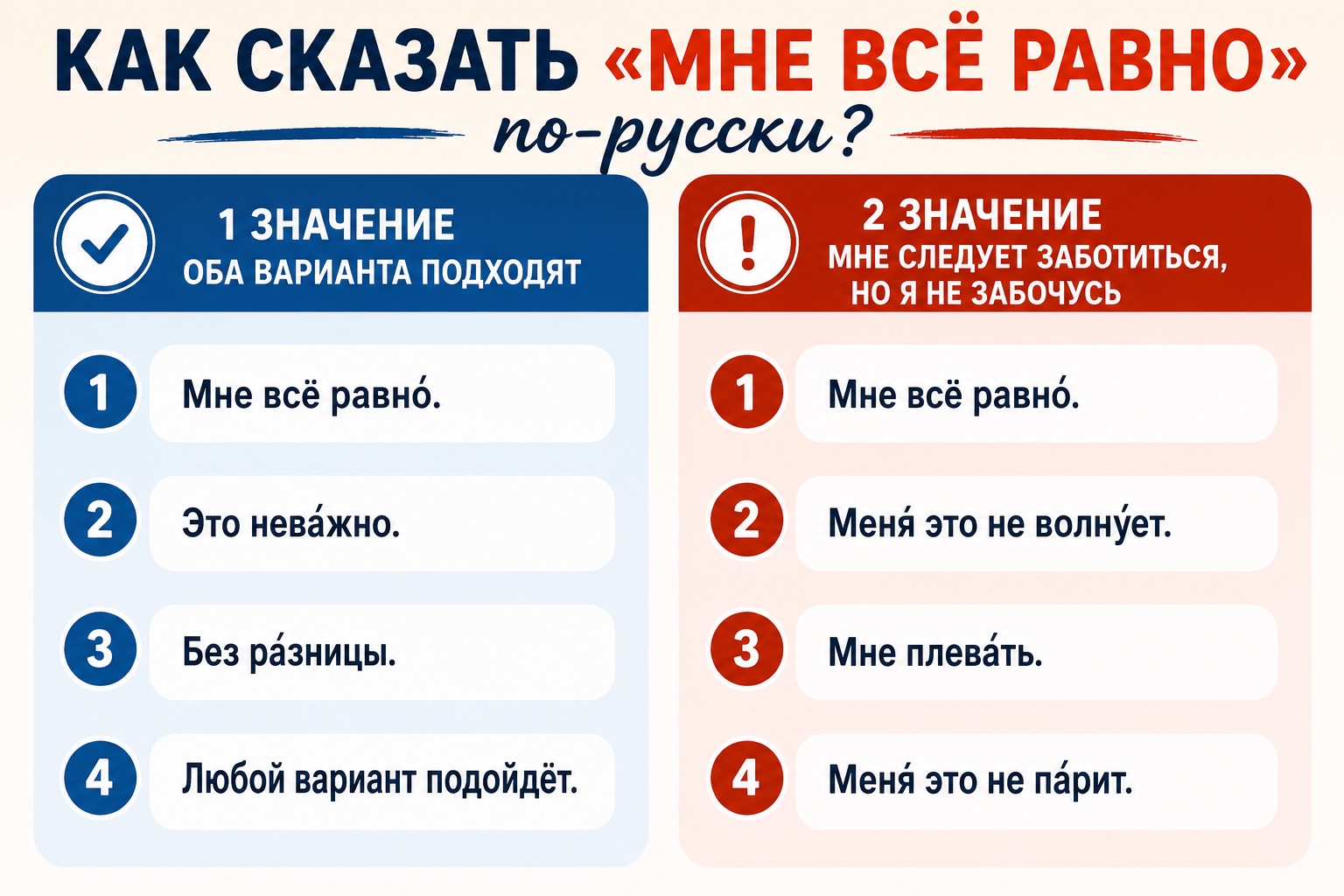
You look up “I don’t care” in a dictionary and find a long list:
Мне всё равно́. Мне без ра́зницы. Мне по́фиг. Мне фиоле́тово. Мне наплева́ть.
They may all be translated as I don’t care—but they are not interchangeable.
Imagine that you are at a job interview and the interviewer asks:
Како́й гра́фик вам подойдёт: с восьми́ до пяти́ и́ли с девяти́ до шести́?
Which schedule would work for you: eight to five or nine to six?
You want to say that either schedule is fine. You could answer:
Мне всё равно́.
Either is fine with me.
But answering: Мне фиоле́тово or Мне наплева́ть would sound dismissive, emotional, and rude.
The difficulty is that both English “I don’t care” and Russian «мне всё равно́» can express two different meanings:
1. Both options are fine with me
2. I don’t care, although other people think I should.
The phrase Мне всё равно́ works in both situations. Its synonyms, however, depend on which meaning you intend.
After identifying the meaning, you must also choose the correct register: formal, neutral, colloquial, or slang.
Meaning 1: I Don’t Care = Both Options Are Fine with Me
In this meaning, “I don’t care” does not express emotional indifference, negligence, or disrespect.
It simply means:
- I have no preference.
- Either option is acceptable.
- Both choices work for me.
- The difference is not important in this situation.
This meaning is usually cooperative and nonconfrontational
FORMAL RUSSIAN
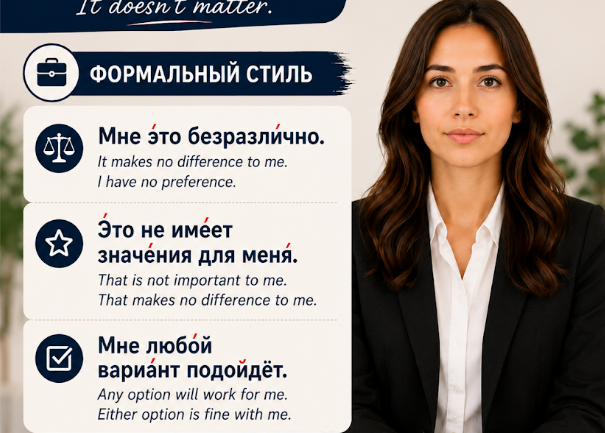
Мне (э́то) безразли́чно.
It makes no difference to me. / I have no preference.
This phrase is formal and restrained. It can be used when discussing alternatives, but it may sound colder than мне всё равно́.
In professional communication, it is usually better to explain what is important to you:
Мне безразли́чно, в како́й день проводи́ть встре́чу.
It makes no difference to me which day we hold the meeting.
Dialogue 1
— Вам удо́бнее встре́титься во вто́рник и́ли в сре́ду?
— Мне безразли́чно. О́ба дня мне подхо́дят.
Dialogue 2
— Како́й из двух прое́ктов вы хоти́те обсуди́ть пе́рвым?
— Мне э́то безразли́чно. Мо́жем нача́ть с любо́го.
Dialogue 1
— Would it be more convenient for you to meet on Tuesday or Wednesday?
— It makes no difference to me. Both days work for me.
Dialogue 2
— Which of the two projects would you like to discuss first?
— I have no preference. We can start with either one.
Э́то не име́ет значе́ния для меня́.
That is not important to me. / That makes no difference to me.
This is a formal, precise, and professional expression. It focuses on the importance of the choice rather than on the speaker’s emotional attitude.
The word order is flexible here:
Э́то не име́ет для меня́ значе́ния. Это для меня не имеет значения. Для меня́ э́то не име́ет значе́ния.
— Вам ва́жно, в како́м поря́дке выступа́ть?
— Нет, для меня э́то не име́ет значе́ния.
— Вы предпочита́ете рабо́тать из до́ма и́ли в о́фисе?
— На да́нном эта́пе э́то не име́ет для меня́ большого значе́ния.
— Is it important to you in what order you speak?
— No, that makes no difference to me.
— Would you prefer to work from home or in the office?
— At this stage, it makes no big difference to me.
(Мне) любо́й вариа́нт подойдёт.
Either option will work for me. / Any option is fine with me.
This is one of the clearest and safest expressions when discussing choices.
It is especially useful in professional situations because it communicates flexibility without sounding indifferent or dismissive.
— Мы мо́жем назначи́ть собесе́дование на понеде́льник и́ли на сре́ду.
— Мне любо́й вариа́нт подойдёт.
— Вы хоти́те получи́ть докуме́нты по по́чте и́ли забра́ть их ли́чно?
— Любо́й вариа́нт подойдёт.
— We can schedule the interview for Monday or Wednesday.
— Either option will work for me.
— Would you like to receive the documents by mail or collect them in person?
— Either option is fine.
NEUTRAL RUSSIAN
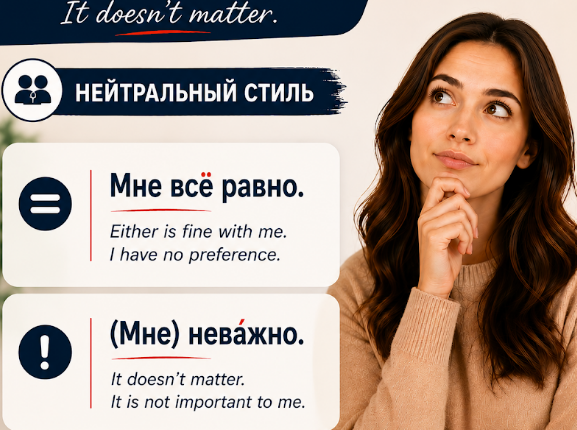
Мне всё равно́.
Either is fine with me. / I have no preference.
This is the most common neutral expression.
In this first meaning, it does not normally sound rude when the context clearly involves a choice between acceptable alternatives.
However, intonation still matters. A friendly or calm мне всё равно́ sounds flexible. A sharp мне всё равно́! can sound irritated.
— Ты бу́дешь чай и́ли ко́фе?
— Мне всё равно́. Выбира́й сам.
— По́йдём в кино́ в семь и́ли в де́вять?
— Мне всё равно́. Я свобо́ден весь ве́чер.
— Will you have tea or coffee?
— Either is fine. You choose.
— Shall we go to the movies at seven or nine?
— Either is fine. I’m free all evening.
(Мне) нева́жно.
It doesn’t matter. Either is fine. (Lit – It is not important to me.)
This phrase is neutral and useful when one detail does not affect your decision.
— Како́го цве́та маши́ну ты хо́чешь?
— Мне нева́жно. Гла́вное, что́бы она́ была́ надёжной.
— Где встре́тимся: у метро́ и́ли у кафе́?
— Нева́жно. Мне удо́бно и там, и там.
— What color car do you want?
— It doesn’t matter to me. The important thing is that it be reliable.
— Where shall we meet: by the metro or by the café?
— It doesn’t matter. Both places are convenient for me.
COLLOQUIAL RUSSIAN
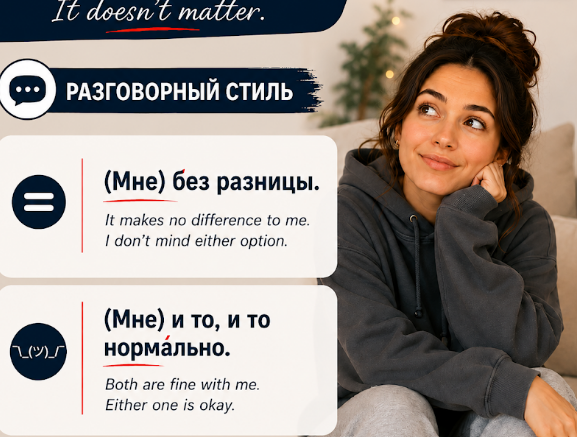
(Мне) без ра́зницы.
Either is fine (with me). Lit – It makes no difference to me.
This is very common in everyday speech.
It is more conversational than мне всё равно́, but in a calm context it does not necessarily express negativity.
It is best used with friends, relatives, and people with whom you have an informal relationship.
— Зака́жем пи́ццу и́ли су́ши?
— Мне без ра́зницы. Я ем и то, и друго́е.
— Где хочешь сесть: у окна́ и́ли у две́ри?
— Без ра́зницы. Сади́сь, где тебе́ удо́бнее.
— Shall we order pizza or sushi?
— Either is fine. I eat both.
— Where do you want to sit: by the window or by the door?
— It makes no difference. Sit wherever is more convenient for you.
(Мне) и то, и то норма́льно.
Both are fine (with me).
This is a natural colloquial way to say that both alternatives are acceptable.
It is friendly, relaxed, and more positive than a brief мне всё равно́.
— Встре́тимся днём и́ли ве́чером?
— И то, и то норма́льно.
— Бу́дем смотре́ть коме́дию и́ли дете́ктив?
— Мне и то, и то норма́льно. Выбира́й ты.
— Should we meet in the afternoon or in the evening?
— Both are fine with me.
— Shall we watch a comedy or a detective film?
— Both are fine with me. You choose.
Are There Slang Expressions for This Meaning?
Not really.
When you are simply saying that both choices are acceptable, there is usually no need for strong slang.
Expressions such as мне по́фиг, мне фиоле́тово, or мне наплева́ть add emotional distance, defiance, or contempt. They do not merely communicate flexibility.
Meaning 2: “I Don’t Care, Although I Probably Should”
In the second meaning, the speaker is not choosing between two equally acceptable options.
The phrase communicates that the speaker is not emotionally invested in something that other people consider important.
Depending on the expression and intonation, it may mean:
- I am not worried about it.
- I do not pay attention to it.
- I do not care what people think.
- I refuse to invest time or emotion in it.
- I know this may have consequences, but I still do not care.
This meaning can sound detached, dismissive, rebellious, confrontational, or rude.
The phrase Мне всё равно́ is also used in this meaning.
Compare:
Мне всё равно́, ка́кой фильм смотре́ть.
Either film is fine with me.
and:
Мне всё равно́, что они обо мне ду́мают.
I don’t care what they think of me.
The same Russian phrase expresses two different meanings. The context determines which one is intended.
FORMAL RUSSIAN
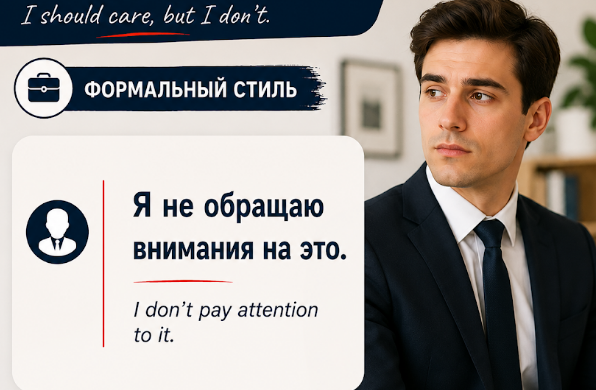
Я не обраща́ю внима́ния НА КОГО/ НА ЧТО.
I do not pay attention to someone or something.
This is a restrained way to say that you deliberately ignore criticism, comments, distractions, or behavior.
It is less emotional than most expressions in this section.
Verb Government
обраща́ть внима́ние на кого́? на что? Use НА + Accusative:
— Вас не задева́ет крити́ка в социа́льных сетя́х?
— Я не обраща́ю внима́ния на анони́мные коммента́рии.
— Колле́ги говоря́т, что э́тот прое́кт не уда́стся.
— Я не обраща́ю внима́ния на подо́бные прогно́зы и продолжа́ю рабо́тать.
— Doesn’t criticism on social media affect you?
— I do not pay attention to anonymous comments.
— Your colleagues say that this project will not succeed.
— I do not pay attention to such predictions and continue working.
NEUTRAL RUSSIAN

Мне всё равно́.
I don’t care.
In this meaning, мне всё равно́ expresses real emotional indifference rather than flexibility.
The context often implies that the issue should matter to the speaker—or that another person believes it should.
It may sound neutral, tired, cold, or dismissive depending on intonation.
— Что лю́ди о тебе́ поду́мают?
— Мне всё равно́, что они поду́мают.
— Ты понима́ешь, что он мо́жет оби́деться?
— Понима́ю, но мне уже́ всё равно́.
— What will people think of you?
— I don’t care what they think.
— Do you understand that he may be offended?
— I do, but I no longer care.
Меня́ э́то не волну́ет.
That does not concern me. / I am not worried about it. / I don’t care about it.
This phrase may express either calm detachment or emotional indifference.
It is less rude than мне наплева́ть, but it can still sound cold when another person expects concern.
— Тебя́ не беспоко́ит, что они тебя́ критику́ют?
— Нет, меня́ э́то не волну́ет.
— Ты мо́жешь потеря́ть их подде́ржку.
— Меня́ э́то не волну́ет. Я всё равно́ сде́лаю по-сво́ему.
— Doesn’t it bother you that they criticize you?
— No, I don’t care about that.
— You may lose their support.
— That does not concern me. I will do it my way anyway.
COLLOQUIAL RUSSIAN
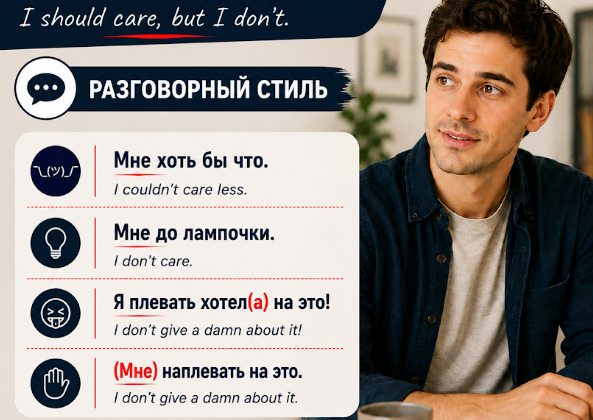
Мне хоть бы что.
It doesn’t bothers me. / He doesn’t even care.
This expression means that the speaker remains unaffected despite difficulties, criticism, illness, fatigue, or consequences.
It may express resilience:
Все уста́ли, а ему́ хоть бы что.
Everyone is tired, but he is completely unaffected.
It may also express irresponsible indifference.
— Ты всю ночь не спал. Как ты себя́ чу́вствуешь?
— Мне хоть бы что. Я ещё и на трени́ровку пойду́.
— Я прошу его уже который раз вынести мусор, а ему хоть бы что! Лежит себе на диване и смотрит телик.
— Какой нахал!
— You didn’t sleep all night. How do you feel?
— I’m completely fine. I’m even going to training.
— I’ve asked him to take out the trash so many times, but he doesn’t even care! He’s just lying on the couch watching TV.
— What a jerk!
Мне до ла́мпочки.
I couldn’t care less. (лампочка – light bulb)
This is a colorful colloquial idiom.
It expresses strong indifference, but it is not obscene. Depending on the tone, it may sound humorous, dismissive, or rude.
— Она́ расска́зывает всем о ва́шей ссоре.
— Мне до ла́мпочки, что она́ расска́зывает.
— Тебе́ не интере́сно, кто выигра́ет?
— Мне до ла́мпочки. Я вообще́ не смотрю́ футбо́л.
— She is telling everyone about your fight.
— I couldn’t care less what she says.
— Don’t you care who wins?
— I couldn’t care less. I don’t watch football at all.
Я плева́ть хоте́л / хоте́ла НА КОГО/ НА ЧТО!
I couldn’t care less about someone or something. (плевать – to spit)
This is highly emotional and confrontational.
It does not simply express indifference. It communicates defiance and often contempt.
The past-tense form agrees with the speaker’s gender:
- Я плева́ть хоте́л — said by a man
- Я плева́ть хоте́ла — said by a woman
Verb Government
плева́ть на кого́? на что? Use НА + Accusative.
— Нача́льник сказа́л, что ты до́лжен извини́ться.
— Я плева́ть хоте́л на его́ тре́бования!
— Все бу́дут тебя́ осужда́ть.
— Я плева́ть хоте́ла на их мне́ние!
— The boss said that you must apologize.
— I couldn’t care less about his demands.
— Everyone will judge you.
— I couldn’t care less about their opinion.
Мне плева́ть/ наплева́ть НА КОГО/ НА ЧТО!
I don’t give a damn about someone or something.
This expression is blunt, emotional, and potentially insulting.
It communicates contemptuous indifference, not a simple absence of preference.
— Что скажут сосе́ди?
— Да мне плева́ть!
— Ты наруша́ешь все пра́вила.
— Мне наплева́ть на э́ти пра́вила.
— What will the neighbors say?
— I don’t give a damn.
— You are breaking all the rules.
— I don’t give a damn about those rules.
Slang: Used by Younger Speakers
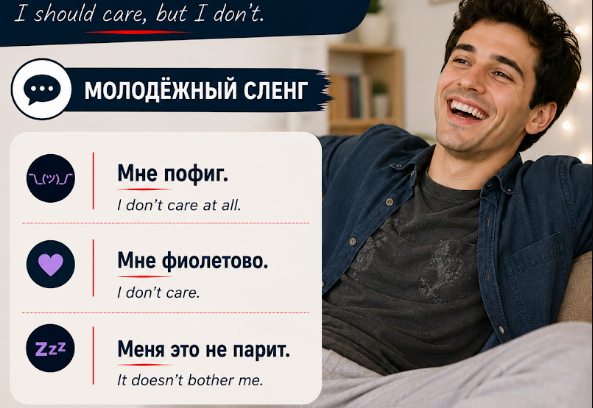
These expressions are not limited exclusively to young people. Older speakers may also know and use them. However, they are especially common in contemporary informal speech among younger and middle-aged speakers.
Меня́ э́то не па́рит.
That doesn’t bother me. / It doesn’t stress me out. (пар – steam)
This modern slang expression usually means that something does not create stress, anxiety, or inconvenience.
It is less aggressive than мне наплева́ть, but it is still inappropriate in formal communication.
— Тебе́ не меша́ет, что здесь так шу́мно?
— Нет, меня́ э́то не па́рит.
— Ты не пережива́ешь из-за экза́мена?
— Меня́ э́то не па́рит. Я хорошо́ подгото́вился.
— Doesn’t it bother you that it is so noisy here?
— No, that doesn’t bother me.
— Aren’t you worried about the exam?
— It doesn’t stress me out. I prepared well.
(Мне) по́фиг.
I don’t care. / I don’t give a damn.
This is extremely common modern slang.
It is not obscene, but it is dismissive and may sound rude—especially if someone is discussing a serious problem or their feelings.
— Тебе́ ва́жно, что они о тебе́ ду́мают?
— Мне по́фиг.
— Ты мо́жешь получи́ть двойку.
— Мне по́фиг. Я уже́ реши́л уйти́ из универа.
— Do you care what they think of you?
— I don’t care.
— You may get an F.
— I don’t care. I have already decided to drop out of the university..
Мне фиоле́тово.
I couldn’t care less.
This is playful, ironic slang.
The color фиоле́товый has no literal connection with indifference. The unexpected image gives the expression its humorous quality.
Even though it may sound humorous, it still expresses emotional detachment and is not suitable for professional conversations.
— Все обсужда́ют э́тот ска́ндал.
— Мне фиоле́тово. У меня́ свои́ пробле́мы.
— Тебя́ не раздража́ет, что он сно́ва опозда́л?
— Мне фиоле́тово. Я его́ не жду.
— Everyone is discussing that scandal.
— I couldn’t care less. I have my own problems.
— Doesn’t it irritate you that he is late again?
— I couldn’t care less. I’m not waiting for him.
Slang: Used by Older Speakers
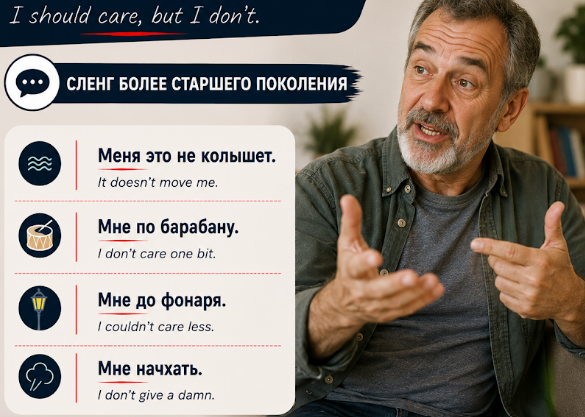
These expressions are familiar to Russian speakers of different ages, but many have a more old-fashioned or established colloquial flavor. Younger people may understand them without using them regularly.
Меня́ э́то не колы́шет.
I couldn’t care less.
The literal verb колыха́ть means to sway or to move gently. Figuratively, the expression means that something does not affect the speaker emotionally.
It is dismissive and can sound rough.
—Он бу́дет недово́лен.
— Меня́ э́то не колы́шет.
— У них совсе́м друго́е мне́ние.
— Меня́ э́то не колы́шет. Я реше́ние не изменю́.
— He will be unhappy.
— I couldn’t care less.
— They have a completely different opinion.
— I couldn’t care less. I will not change my decision.
Мне до фонаря́.
I couldn’t care less. (фонарь – lenten)
This established colloquial expression is similar to мне до ла́мпочки.
It sounds colorful and dismissive but is not obscene.
— Тебе́ не интере́сно, чем всё зако́нчится?
— Мне до фонаря́.
— Она́ опя́ть на тебя́ жа́луется.
— Мне до фонаря́, что она́ говори́т.
— Aren’t you interested in how it all ends?
— I couldn’t care less.
— She is complaining about you again.
— I couldn’t care less what she says.
Мне по бараба́ну.
I couldn’t care less. / It makes absolutely no difference to me. (барабан – drum)
This is a well-established slang or strongly colloquial expression.
It frequently communicates dismissive indifference and sounds inappropriate in professional communication.
— Ты за одну́ кома́нду и́ли за другу́ю?
— Мне по бараба́ну. Я не боле́льщик.
— Они мо́гут отка́заться тебе́ помога́ть.
— Мне по бараба́ну. Я спра́влюсь сам.
— Do you support one team or the other?
— I couldn’t care less. I’m not a fan.
— They may refuse to help you.
— I couldn’t care less. I’ll manage by myself.
(Мне) начха́ть НА КОГО/ НА ЧТО.
I don’t give a damn about someone or something. (чихать – to sneeze)
This expression is highly emotional and dismissive.
It comes from the verb чиха́ть, to sneeze, but its idiomatic meaning is not connected with literal sneezing.
It is often rude and should be reserved for highly informal situations.
Verb Government
начха́ть на кого́? на что? Use НА + Accusative.
— Лю́ди бу́дут тебя́ осужда́ть.
— Да мне начха́ть на их мне́ние!
— Они угрожа́ют пода́ть жа́лобу.
— Да мне начха́ть на их угро́зы!
— People will judge you.
— I don’t give a damn about their opinion.
— They are threatening to file a complaint.
— I don’t give a damn about their threats.
Summary: Why Dictionaries Can Be Misleading
Many bilingual dictionaries place all translations of “I don’t care” in one list.
A learner sees:
- мне всё равно́
- мне без ра́зницы
- мне фиоле́тово
- мне наплева́ть
and assumes that these expressions differ only in style.
But there are actually two decisions to make.
First, identify the meaning:
- Are both options acceptable?
- Or are you expressing emotional indifference to something that is expected to matter?
Then choose the register:
- formal,
- neutral,
- colloquial,
- or slang.
You cannot choose the appropriate Russian expression until you have answered both questions.
A Practical Rule
- When you mean “Either option is fine,” choose a phrase that describes flexibility:
Formal:
- Мне безразли́чно
- Э́то не име́ет значе́ния для меня.
- (Мне) любо́й вариа́нт подойдёт
Neutral:
- Мне всё равно́
- (Мне) нева́жно
Colloquial:
- (Мне) без ра́зницы
- (Мне) и то, и то норма́льно
- When you mean “I don’t care, even though I am expected to care,” choose a phrase that matches the strength of your emotion:
Formal:
- Я не обращаю внимания на это.
Neutral:
- Мне всё равно́.
- Меня́ э́то не волну́ет.
Colloquial:
- Мне хоть бы что.
- Мне до ла́мпочки.
- Я плевать хотел(а) на это.
- (Мне) плевать/ наплевать на это.
Youth slang:
- Мне по́фиг.
- Меня это не парит.
- Мне фиолетово.
Older generation slang:
- Меня это не колышет.
- Мне по барабану.
- Мне до фонаря.
- Мне начха́ть.
The stronger the expression, the more careful you must be about the situation and your relationship with the listener.
Continue building your natural spoken Russian with 25+ ways to say “I agree” in Russian.
Stop Translating Words. Start Choosing Meaning.
Knowing that Мне всё равно́ means I don’t care is not enough to make your Russian sound natural.
Real fluency begins when you can hear the difference between flexibility and indifference, choose the appropriate register, and understand what your words communicate beyond their dictionary translation.
That is exactly what the METRO: Conversational Russian books are designed to teach.
The METRO series helps intermediate learners move beyond one-word translations and isolated vocabulary lists. Through natural dialogues, contemporary everyday topics, audio, and systematic speaking practice, you learn how Russians actually express opinions, reactions, preferences, emotions, and attitudes—and which expression fits each real-life situation.
Do not remain stuck using the same safe textbook phrases in every conversation.
Choose your next METRO book today and start building the flexible, precise, natural Russian you need for real communication.