If your Russian sounds repetitive, it may not be because your grammar is weak.
It may simply be because you only know one way to express each idea.
Native speakers rarely repeat the same phrase over and over. Instead, they choose from several expressions depending on how tired they actually are.
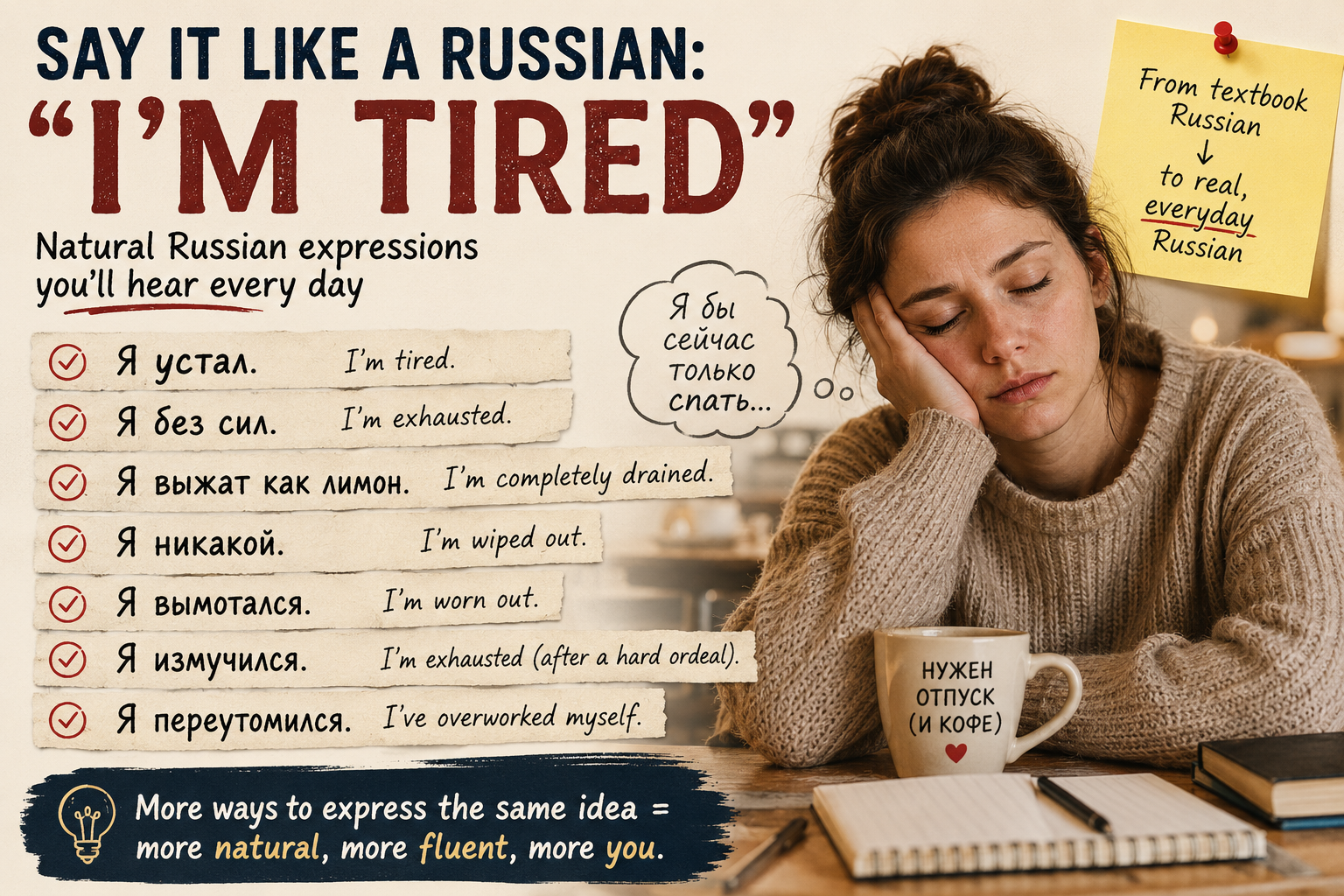
Here are some of the most common ways Russians say “I’m tired.”
Я уста́л. / Я уста́ла. – I’m tired.
Example: После́ рабо́ты я уста́л. I’m tired after work.
Infinitives:
устава́ть(to get tired; to be getting tired, used to get tired) Imperfective
уста́ть(to be tired) Perfective
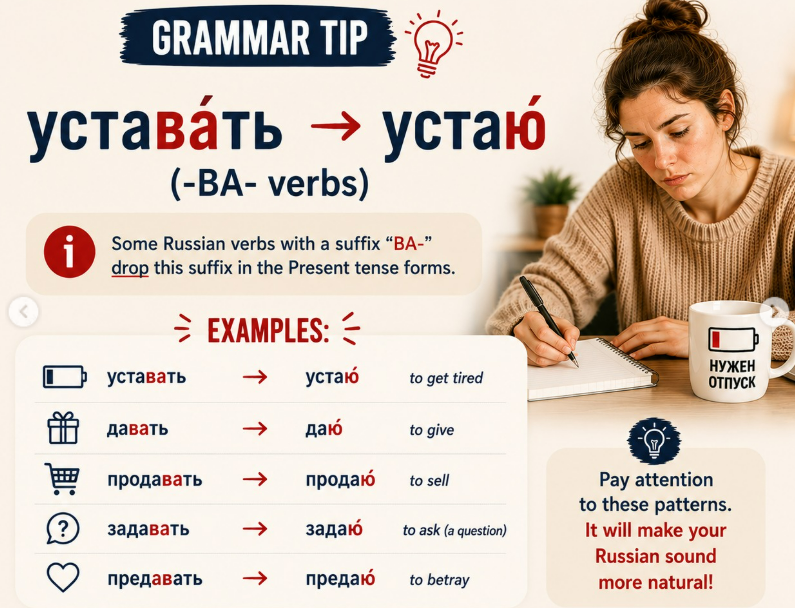
💡 Grammar Tip
Уста-ва́-ть is a -ВА- type of verb, just like да-ва́-ть.
Notice what happens to -ВА- in the Present Tense:
я уста-ю́(I get tired / I’m getting tired)
ты уста-ёшь
они́ уста-ю́т
-> The -ВА- disappears in the Present Tense.
Nothing happens to -ВА- in the Past Tense:
я уста-ва́-л(I used to get tired / I was getting tired)
я уста-ва́-ла
мы уста-ва́-ли
-> The -ВА- stays in the Past Tense.
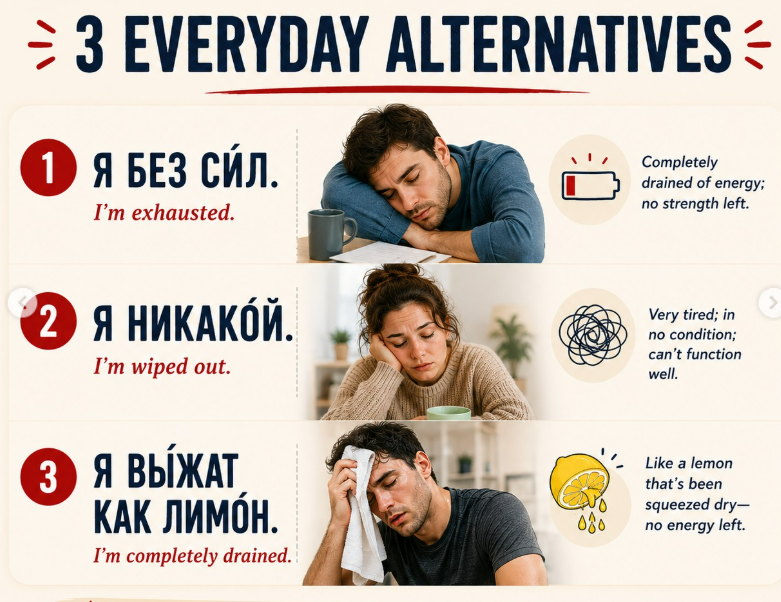
Я без си́л. – I’m exhausted.
This is a colloquial expression.
Literally: I have no energy left. Completely drained of energy; no strength left
Usually it is used with the adverbs “про́сто” or вообще́”. Both adverbs mean “completely, totally” with “без сил”
Example: После́ рабо́ты я про́сто без си́л. I’m completely exhausted after work.
Я вы́жат как лимо́н. / Я вы́жата как лимо́н. – I’m completely drained.
Literally: I feel like a lemon that‘s been squeezed dry – no energy left.
One of the most common Russian colloquial idioms for complete exhaustion.
Example: После́ э́той неде́ли я вы́жат как лимо́н. After this week, I’m completely drained.
Я никако́й. / Я никака́я. – I’m wiped out.
A very colloquial expression.
It suggests that you’re so tired you can barely function; in no condition.
Example: По́сле перелёта я вообще́ никако́й. After the flight, I’m completely wiped out.
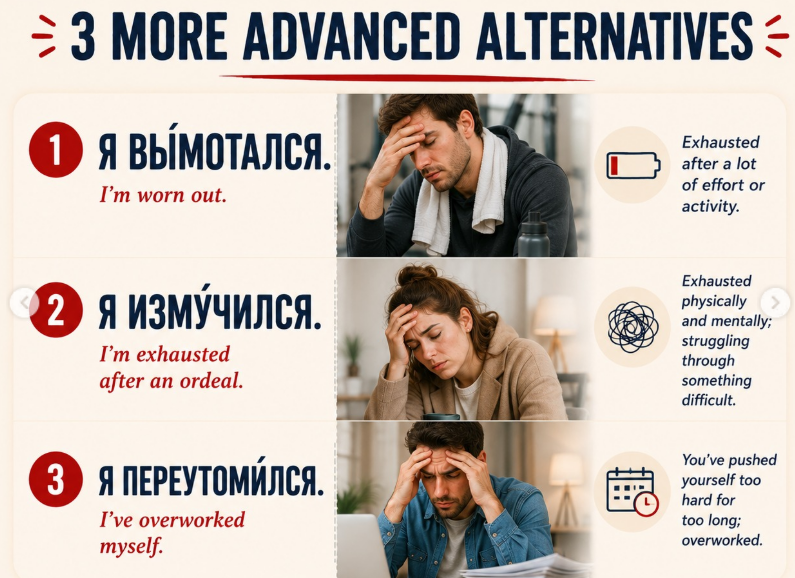
Я вы́мотался. / Я вы́моталась. – I’m worn out.
This colloquial word implies you’ve become exhausted after a lot of physical or mental effort or activity.
Example: Я вы́мотался за время ремонта. I got worn out during the renovation.
Я изму́чился. / Я изму́чилась. – I’m exhaustedafter an ordeal.
This word often suggests you’ve suffered through something difficult, stressful, or unpleasant—not just physical fatigue; exhausted physically or mentally.
Example: Я всю ночь не спал. Совсе́м изму́чился. I didn’t sleep all night. I’m completely exhausted.
Я переутоми́лся. / Я переутоми́лась. – I’ve overworked myself.
This is a more formal expression. You’ll hear it in conversations about work, studying, health, or burnout.
You are tired because you’ve pushed yourself too hard for too long; overworked.
Example: Мне ка́жется, ты переутоми́лся. Пора́ отдохну́ть. I think you’ve overworked yourself. It’s time to get rest.
Which One Should You Learn First?
Start with these four:
✓ Я уста́л.(I’m tired.) ✓ Я без си́л.(I’m exhausted.) ✓ Я вы́жат как лимо́н.(I’m completely drained.) ✓ Я никако́й.(I’m wiped out.)
These are the expressions you’ll hear most often in everyday Russian.
The others are excellent additions that help you express more specific shades of meaning.
Advanced speakers don’t necessarily know more grammar.
They simply have more natural ways to express the same idea.
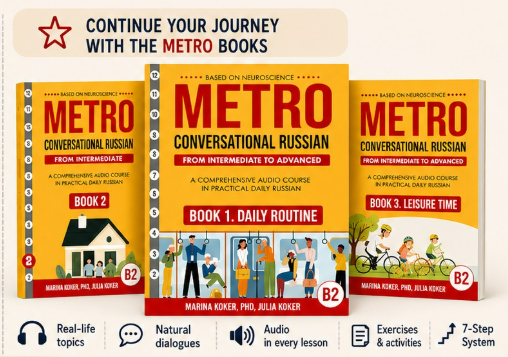
Expressions like Я никако́й, Я вы́жат как лимо́н, and dozens of other colloquial phrases educated Russians use when they talk about everyday life, appear throughout the METRO books in realistic stories.
Instead of memorizing isolated vocabulary lists, you’ll learn these expressions in context—the same way native speakers actually use them. That’s what makes them easier to remember and easier to use in your own conversations.
Explore the METRO audio course and start building a richer, more natural Russian vocabulary today.
If you found this lesson helpful, please consider sharing it on social media with other Russian learners. It can help them feel more confident and less stuck at the Intermediate level. It also helps me continue creating practical Russian study materials. And thank you for being part of this learning community!